
At first glance the differences on how Catholics and Protestants number the commandments seem insignificant or possibly nonsensical especially between non-Catholic Christian sects. The case is similar for atheists and non-believers for different reasons This is a chart comparing Catholic and Protestant numbering of the Commandments is from the Word of Mercy website specifically the URL at Catholic vs Protestant Ten Commandments: What’s the Difference and Why It Matters – Word of Mercy. If you are a catechist and want a copy for your classroom, click here for a downloadable PDF.
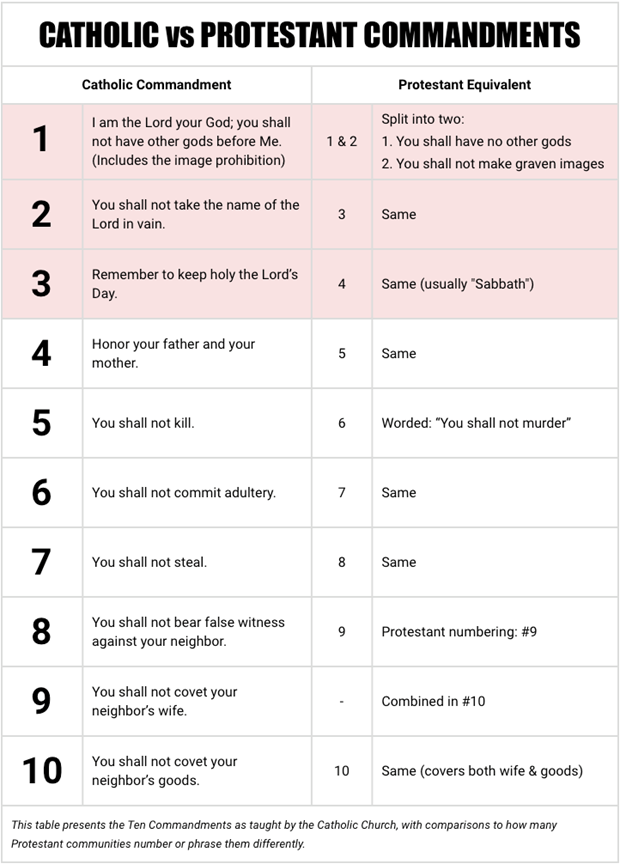
Some of the differences are covered in the aforementioned website. But let us start with the first commandment. The fact is that the protestants in the fifteen-hundreds had an agenda. Before that, since Roman Catholics and Greek/Russian Orthodox were the only recognized Christian sects, their numbering of the commandments were the same. One of the first things, if not actually the first sold thing, to be printed on the newly invented Gutenberg printing press was the Latin Vulgate version of the Bible. The content of the Old Testament section of this Bible was almost identical to the Greek Septuagint. It was Martin Luther, based on the canon most recently approved, in the fifteen hundreds by the Jewish rabbis of Jerusalem. These were the Jews, whom it is recorded that Martin Luther disliked, and whom (the rabbis that is) literature relates had tried to down play any scripture relating to Jesus Christ to the point of not discussing Isaia Chapter 53. This being the case why would they include anything they thought might point to Jesus being the Messiah or his message that would lead to the salvation of the most souls if they could use any justification to eliminate them.
A clearer explanation of why the Rabbis would try to downplay or downright refuse to talk about the most world changing prophecy of the Bible, Isaia 53? Well, the following is a quote from the Google AI Overview:
AI Overview
Isaiah 53 is called the “forbidden chapter” because it describes a suffering servant, which Christians identify as Jesus, but which many Jewish people do not. The chapter was once read in synagogues but was later removed from the weekly readings because its interpretation led to significant theological arguments and confusion, as it was used by early Christians to argue that Jesus was the Messiah. Many modern Jews believe the passage refers to the nation of Israel, Isaiah, or another Jewish figure, rather than an individual Messiah.
Reasons for the “forbidden” status
- Christian interpretation:
Christians believe the chapter is a clear prophecy of Jesus’s suffering, death, and resurrection, as it describes someone being “pierced for our transgressions” and “crushed for our iniquities”.
- Jewish interpretation:
Many modern Jewish interpreters believe the “suffering servant” refers to the Jewish people as a whole, or a righteous figure like Isaiah or Moses, and that a suffering Messiah is not a Jewish belief.
- Historical context:
Ancient Jewish sages once agreed the chapter was a prophecy about the Messiah. However, after the rise of Christianity, the chapter became a source of controversy because of its perceived connection to Jesus.
- Change in synagogue readings:
To avoid the resulting arguments and confusion, rabbis decided to remove Isaiah 53 from the weekly Haftarah (prophetic readings) in some synagogues, leading to its reputation as a “forbidden chapter”.
But surely like most prophesies (think Nostradamus) its pretty vague. I don’t know, it seems pretty clear to me, a traditional practicing Roman Catholic that it must be referring to Jesus Christ, but you decide (taken from the Douay-Rheims Catholic version of the Bible the following is Chapter 53 of Isaias in its in its entirety):
1.Who hath believed our report? and to whom is the arm of the Lord revealed? 2 And he shall grow up as a tender plant before him, and as a root out of a thirsty ground: there is no beauty in him, nor comeliness: and we have seen him, and there was no sightliness, that we should be desirous of him: 3 Despised, and the most abject of men, a man of sorrows, and acquainted with infirmity: and his look was as it were hidden and despised, whereupon we esteemed him not. 4 Surely he hath borne our infirmities and carried our sorrows: and we have thought him as it were a leper, and as one struck by God and afflicted. 5 But he was wounded for our iniquities, he was bruised for our sins: the chastisement of our peace was upon him, and by his bruises we are healed.
6 All we like sheep have gone astray, every one hath turned aside into his own way: and the Lord hath laid on him the iniquity of us all. 7 He was offered because it was his own will, and he opened not his mouth: he shall be led as a sheep to the slaughter, and shall be dumb as a lamb before his shearer, and he shall not open his mouth. 8 He was taken away from distress, and from judgment: who shall declare his generation? because he is cut off out of the land of the living: for the wickedness of my people have I struck him. 9 And he shall give the ungodly for his burial, and the rich for his death: because he hath done no iniquity, neither was there deceit in his mouth. 10 And the Lord was pleased to bruise him in infirmity: if he shall lay down his life for sin, he shall see a long-lived seed, and the will of the Lord shall be prosperous in his hand.
11 Because his soul hath laboured, he shall see and be filled: by his knowledge shall this my just servant justify many, and he shall bear their iniquities. 12 Therefore will I distribute to him very many, and he shall divide the spoils of the strong, because he hath delivered his soul unto death, and was reputed with the wicked: and he hath borne the sins of many, and hath prayed for the transgressors.
Lets take the Catholic numbering of the commandments one by one comparing them to how they were combined or split up by the protestants after 1500 (a millennia and a half after the catholic church came into existence with its originator, Jesus Christ). Once again lets start with a look at the actual scripture taken from the Douey-Rheims Bible.
[1] And the Lord spoke all these words: [2] I am the Lord thy God, who brought thee out of the land of Egypt, out of the house of bondage. [3] Thou shalt not have strange gods before me. [4] Thou shalt not make to thyself a graven thing, nor the likeness of any thing that is in heaven above, or in the earth beneath, nor of those things that are in the waters under the earth. [5] Thou shalt not adore them, nor serve them: I am the Lord thy God, mighty, jealous, visiting the iniquity of the fathers upon the children, unto the third and fourth generation of them that hate me:
[6] And shewing mercy unto thousands to them that love me, and keep my commandments. [7] Thou shalt not take the name of the Lord thy God in vain: for the Lord will not hold him guiltless that shall take the name of the Lord his God in vain. [8] Remember that thou keep holy the sabbath day. [9] Six days shalt thou labour, and shalt do all thy works. [10] But on the seventh day is the sabbath of the Lord thy God: thou shalt do no work on it, thou nor thy son, nor thy daughter, nor thy manservant, nor thy maidservant, nor thy beast, nor the stranger that is within thy gates.
[11] For in six days the Lord made heaven and earth, and the sea, and all things that are in them, and rested on the seventh day: therefore the Lord blessed the seventh day, and sanctified it. [12] Honour thy father and thy mother, that thou mayest be longlived upon the land which the Lord thy God will give thee. [13] Thou shalt not kill. [14] Thou shalt not commit adultery. [15] Thou shalt not steal.
[16] Thou shalt not bear false witness against thy neighbour. [17] Thou shalt not covet thy neighbour’s house: neither shalt thou desire his wife, nor his servant, nor his handmaid, nor his ox, nor his ass, nor any thing that is his. [18] And all the people saw the voices and the flames, and the sound of the trumpet, and the mount smoking: and being terrified and struck with fear, they stood afar off, [19] Saying to Moses: Speak thou to us, and we will hear: let not the Lord speak to us, lest we die. [20] And Moses said to the people: Fear not: for God is come to prove you, and that the dread of him might be in you, and you should not sin.
Now to be fair it can be seen how they might logically say that: “Thou shalt not have strange Gods before me.” And “Thou shalt not make to thyself a graven thing, nor the likeness of any thing that is in heaven above, or in the earth beneath, nor of those things that are in the waters under the earth.” But that being the case why is “Thou shalt not adore them, nor serve them.” This is logical but Catholics (the only recognized Christians before Martin Luther, others were labeled heretics by the Catholic Church including protestant sects after Martin Luther), as others before Martin Luther all the way back to the 3rd century for Christians, referred to them as the 10 commandments (in fact they are popularly referred to as the Decalogue) and in the original Hebrew culture referred to as the “Ten Words.” To have added Thou shalt not adore them, nor serve them would have made them the 11 commandments and that of course would not have played well with cradle Catholics Martin Luther was trying to convert to his new religion. The Google AI overview is quoted as follows:
These are results for When Did the commandments first come to be identified as “the 10 commandments.”
Search instead for When Did the commandments first come to be identified as “the 10 comandments.”
AI Overview
The name “the Ten Commandments” originated with the Greek translation of the Hebrew Bible, which occurred
between the 3rd and 2nd centuries BCE. The original Hebrew texts refer to them as “the ten words,” which was later translated into the Greek deka logoi, or Decalogue.
Development of the name
- Original Hebrew: “Ten Words”: In the Hebrew texts of Exodus and Deuteronomy, the laws are called ʿĂśéreṯ had-Dibbərôṯ, which translates to “the ten words” or “the ten sayings”. This phrasing was repeated in the books of Exodus (34:28), Deuteronomy (4:13), and Deuteronomy (10:4).
- Greek translation: Dekálogos: The Septuagint, the Koine Greek translation of the Hebrew Bible, translated “ten words” into dekálogos. This is the origin of the term “Decalogue” used in theological and academic settings.
- Early English translations: In the 16th century, early English biblical translations, such as the Tyndale and Coverdale versions, used the phrase “ten verses”.
- Widespread use of “Ten Commandments”: The title “Ten Commandments” gained widespread recognition through later English translations, including the Geneva Bible and the King James Version (Authorized Version).
Clarifying the term
It is important to note that the biblical texts themselves refer to the commandments as “ten words,” not “ten commandments.” This linguistic detail highlights that the popular title is an interpretive development over time. The exact numbering and division of these commandments differ slightly among Jewish, Catholic, and Protestant traditions, demonstrating that there is not a single, universal version.
But why split it up this way, Martin Luther must have been aware of how the Catholic Church had always divide up the 10 commandments. But he was trying to drive a wedge between the common people and the Catholic church and propagated the lie that Catholics worshiped the statues of saints, the chief of whom had been the Virgin Mary – mother of God (Jesus Christ), that were in almost all Catholic churches at the time. The point is that Catholics never worshiped those statues, but merely saw them as people who had lived exceptionally holy lives, and “prayers” used in this context was the term used to ask these dead saints to appeal to almighty God, since they were thought to have lived lives holy enough (and previously confirmed by 3 miracles and a devil’s advocate to insure no “cheating” as to determining their holiness) to have good assurance of being in God’s presence, in heaven, and able to add their prayers for the petitions of the one “praying” (not worshipping the saint, since God Almighty – the Holy Trinity, alone is worthy of worship). The Apostles Creed (according to google AI Overview), was created about the second century AD, some 12 centuries before the protestant reformation, speaks of the communion of saints. The communion of saints assumes 3 groups of Catholics: the church militant (those on earth that have not yet died), the church suffering (those in purgatory undergoing purification to become perfect as required in Matthew 5:48) and the Church triumphant (those humans who are already acquired heaven). Those who are assumed in heaven are those who we ask to pray for us (that asking is what Catholics sometimes referred to as “praying” to the saints).
This is my argument for why protestants split this commandment into two. But what is my argument for them staying together as Catholics propose? Once again according to an AI overview searching on the phrase “what is a graven thing as described in exodus in the bible,” and alternate translation of Exodus 20:4-5 is “You shall not make for yourself an idol, or any likeness of what is in heaven above or on the earth beneath or in the water under the earth. You shall not worship them or serve them; for I, the LORD your God, am a jealous God.” Using this translation you have the word idol. Some irreverent people feel that this being the first commandment shows pride or conceit on God’s part making his worship more important than not murdering your fellow man which should be first. But the minor argument is as Jesus Christ, the Second Person of the Blessed Trinity, saying he was God is not blasphemy because He is God, God the Father, the First Person of the Blessed Trinity requiring worship is not conceit because He created everything including the one with this opinion. The fact is, that the admonition to worship God with your whole being and not idolize anything else, necessarily needs to be first. Why? If God is the most important thing in your life, and you “idolize” God, you will make sure to follow His commandments. That why the admonitions to worship God and have no Gods or idols beside Him should be together. Hitler idolized power instead of God and it led to violating the 5th commandment, “Thou shall not kill,” causing the deaths of millions (to include his own suicide). Bill Gates Idolizes wealth/money which led to violating the 8th commandment “thou shalt not bear false witness against they neighbor” (saying potentially harmful vaccines or medicines had no harmful effects, despite knowing the fact that myocarditis might be a side effect of some widely touted vaccines, and should be used by everyone to hopefully make him money) conceivably causing the illness of millions. Bernie Madoff idolizing greed, leading to breaking the 7th commandment, “thou shall not steal.” Finally, Jeffrey Epstien idolizing lust, which led to violating the 6th commandment, “thou shall not commit adultery (Ghislaine Maxwell, Jeffrey Epstein’s girlfriend, was secretly married to tech CEO Scott Borgerson in 2016, Epstein died by suicide in 2019).
The fact is when you idolize someone or something other than God you face unhappiness in this world and the next. Hitler and Epstein committed suicide, Madoff is in jail and Bill Gates is ostracized and divorced. All the commandments are really summarized in Luke 10:27: “And he answered, ‘You shall love the Lord your God with all your heart and with all your soul and with all your strength, and with all your mind, and your neighbor as yourself.” If you love God you respect him and keep his commandments. It makes logical sense that the first 3 should be for God and that His worship goes with those commandments which apply to only Him. One, love God with your whole being, two, respect his name out of reverence to him (I think He also made this number 2 as a concession to the souls that are damned to have the almost non-existent satisfaction of cursing His name as against his second commandment for all eternity, though their skin be on fire and worms consume them constantly). This is an easily recognizable quality showing your mindfulness and love of God. Commandment number 3 is the transition from love God with your whole being and love your neighbor as yourself. If you attend Sunday mass as honoring the new lord’s day (established since in Matthew 28:18 Jesus said: All authority has been given to me in heaven and on earth and his church started this custom shortly upon his resurrection), which occurred on Easter Sunday), you learn what the lord requires of you in the Epistle and the Gospel and the sermon or homily.
Commandment number 4, “honor thy father and thy mother” is the segway from the commandments purely about God in that God is the ultimate father and emphasizes that authority is given by God to all legitimate governments (John 19:11). The last two commandments were real tripping point, supposedly, for Martin Luther. In reading about him He asks what man does not covet and that no man can do that so God could not have meant us to actually do it, and that our sins can only be covered, that we cannot actually avoid sin and purify ourselves. But as great saints have agreed with him, alone we cannot, but with prayer and the power of God supplying the help we need we can, as all the great saints have shown and have been able to purify themselves. For in John 15:5 Jesus Himself tells us: “I am the vine; you the branches: he that abideth in me, and I in him, the same beareth much fruit: for without me you can do nothing.” [emphasis mine] We must pray always and work with our Lord Jesus Christ to be successful in purifying and perfecting ourselves. In Matthew 5:48 Christ tells us that we must “Be perfect, therefore, as your heavenly Father is perfect.” This is how we know we can achieve this but if we can get close, there is purgatory, where the bad is burned away, to bring us the rest of the way (1 Corinthians 3:10-16) so that we may be saved.
Thanks to Martin Luther, protestants run the last two commandments on covetousness together into one commandment. But coveting another’s goods (commandment 10) is, in my opinion, is at the heart of the scourge of communism/socialism and that is why these 2 government systems have failed 20 out of the last 20 times they were tried, Germany, Russia and Venezuela being some of the most recent failures. But the story of Helen of Troy shows us how coveting another’s wife, commandment 9, is a totally different situation from commandment 10, which can, in its own way, separate from property, cause the death of thousands. So in my opinion commandment 10 and commandment 9 should be separate in that each can cause great damage by its own “merits.”
Hopefully, I have made my point that commandments one and two in the protestant enumeration of the 10 commandments should be combined to make the first commandment strong enough to command its first priority in the list of commandments and that their combination as the first catholic commandment makes sense. Additionally, I also hope to have shown how the last 2 commandments should be seperate, since one focuses on jealosy and greed and the other focuses on jealosy and lust.
 Traditional Thomistic Catholic