Category: Religion

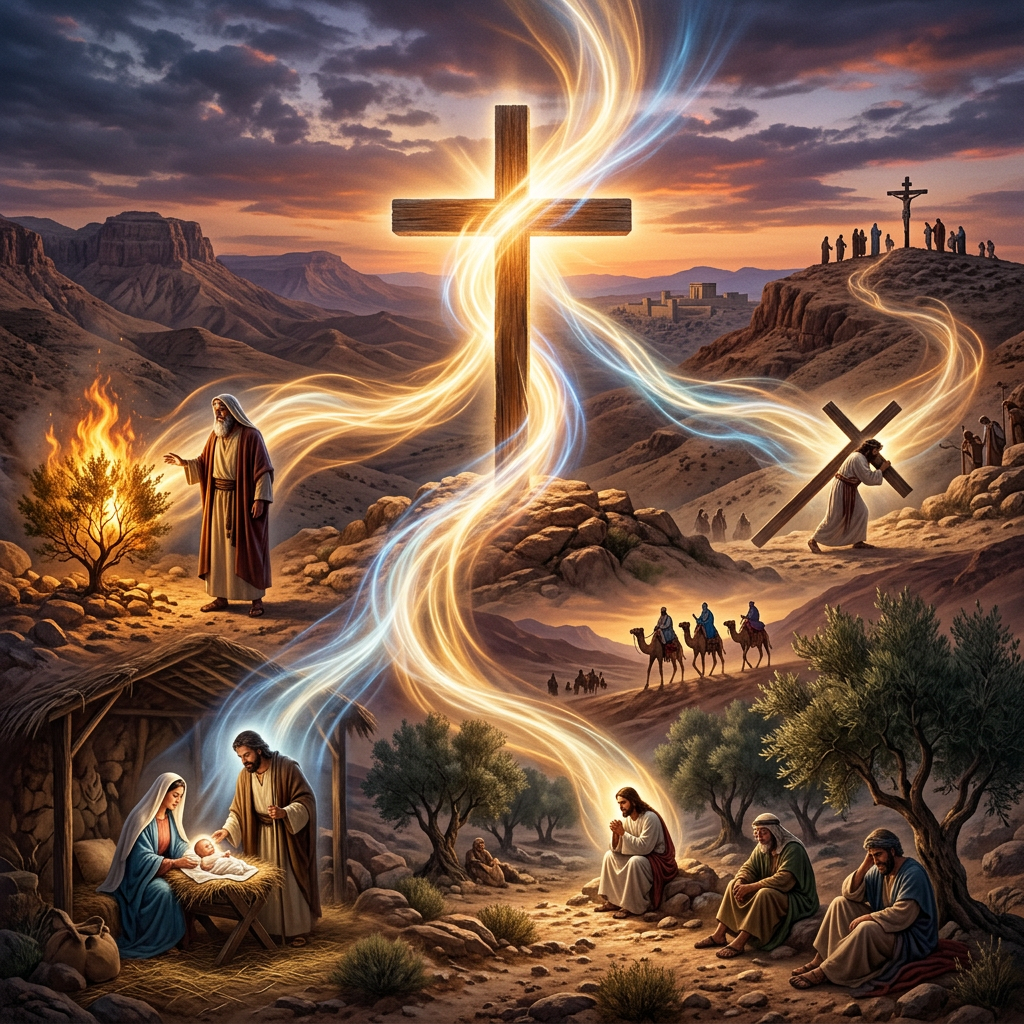
  • Types of Our Lord and Our Blessed Mother in the Old Testament

    Types of Our Lord and Our Blessed Mother in the Old Testament

    These lists are taken from the pamphlet Christian Doctrine Drills: For use in the Parochial School published by D.B. Hansen & Sons, Chicago Illinois, printed circa 1964.

    Types of Our Lord

    1. Adam                        8. Moses
    2. Noah                         9. David
    3. Abraham                 10. Jonas
    4. Abel                         11. Melchisadech
    5. Jacob                       12. The Pascal Lamb
    6. Issac                        13. The Brazen Serpent
    7. Joseph                    14. The Manna

    Types of Our Blessed Mother

    1. Eve
    2. Ruth
    3. Esther
    4. judith
  • What is the Definition of a “Type” from the Bible

    What is the Definition of a “Type” from the Bible

    The following blog is a quote from the results of a search, on the title above, which gave the AI overview that follows.  Many religious articles speak of types from the Bible and since it is a definition and I though the results were good I am posting it here below:

    In the Bible, a type is a person, thing, or event from the Old Testament that prophetically foreshadows a person, thing, or event in the New Testament. It is a form of symbolism where an Old Testament “shadow” or “figure” points to a New Testament “antitype” or “fulfillment”. The New Testament itself identifies many types, such as the Passover lamb prefiguring Christ, the Old Testament sacrificial system pointing to Christ’s ultimate sacrifice, and the flood of Noah’s day symbolizing baptism. 

    Characteristics of a biblical type

    • A prefigurative symbol: A type is a “prophetic symbol” intended by God to represent something future.
    • A pattern or model: The Greek word for “type” (tupos) can mean “pattern,” “model,” or “figure”.
    • Real and independent: A type must be a real person, object, or event in the Old Testament, not just an imagined parallel.
    • Foreshadows a future reality: The Old Testament event or person has its own existence, but its purpose was to prefigure a corresponding person, thing, or action in the New Testament. 

    Examples of biblical types

    • Personal types: People whose lives foreshadow Christ or others.
      • Adam: Described in Romans 5:14 as a “figure of him that was to come,” referring to Christ.
      • Joseph: His life of suffering and eventual exaltation to save others has a typological pattern that foreshadows Jesus.
    • Historical types: Events from the Old Testament that prefigure New Testament realities.
      • The Exodus: Israel’s deliverance from bondage in Egypt foreshadows the salvation offered through Christ.
      • Noah’s flood: 1 Peter 3:20–21 uses the “figure” of Noah’s ark as a type of baptism.
    • Ritual types: Sacrifices, rituals, and objects in the Old Testament that foreshadow New Testament realities.
      • The Passover lamb: A key type of Christ, the “Lamb of God”.
      • The Tabernacle and priesthood: The high priest’s yearly entrance into the Holy of Holies prefigured Christ’s role as our great High Priest.
      • The Brazen Serpent: The brass serpent Moses created to heal the Israelites who had been bitten by venomous snakes is a type of the cross, where looking to it brought healing. 
  • The New Testament Passages which Justify the Seven Catholic Sacraments

    The New Testament Passages which Justify the Seven Catholic Sacraments

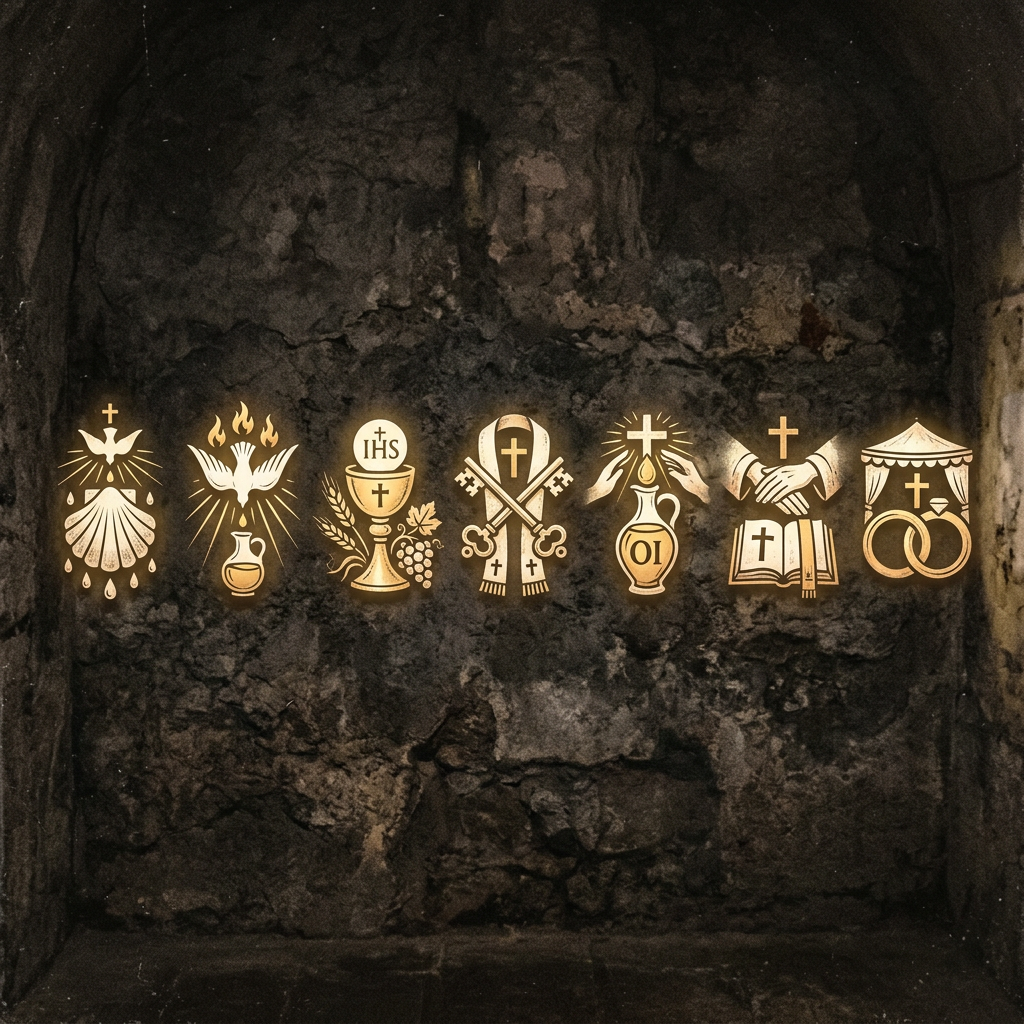
           Many protestant sects argue about some of the sacraments being in the Bible, I feel mostly to downplay the necessity or legitimacy of priests.  Now, don’t get me wrong, some people may see certain verses calling out a particular sacrament as a stretch, but those verses do exist. The following is taken from a pamphlet entitled “Christian Doctrine Drills: For use in Parochial Schools,” published by D.B. Hansen & Sons, Chicago, Illinois, publish circa 1964.

    Baptism

         And Jesus coming, spoke to them, saying: “All power is given to Me in heaven andin earth. Go, therefore, teach ye all nations: baptizing them in the name of the Father, and of the Son, and of the Holy Ghost, teaching them to observe all things whatsoever I have commanded you: and behold I am with your all days, even to the consummation of the world (Matt. 28:18-20)

    Confirmation

         Now when the Apostles, who were in Jerusalem, had heard that Samaria had received the word of, they sent unto them Peter and John, who, when they were come, prayed for them, that they might receive the Holy Ghost, for He was not as yet come upon any of them; but they were only baptized in the name of the Lord Jesus.  Then they laid their hands upon them, and they received, the Holy Ghost. (Acts 8:14-17 and John 16:7)

    Holy Eucharist [also known as Holy Communion]

         And whilst they were at supper, Jesus took bread and blessed and broke, and gave it to His disciples, and said: “Take ye and eat: This is My Body.”

         And taking the chalice, He gave thanks, and gave to them saying:  “Drink ye all of this: for this is My Blood of the New Testament which shall be shed for many unto remission of sins.” (Matt. 26:26-28)

    Penance

         Jesus said to them: “Peace be to you. As the Father hath sent me, I also send you.”

         When He had said this, He breathed on them; and He said to them: “Receive thee ye the Holy Ghost. Whose sins you shall forgive, they are forgiven them and whose sins you shall retain, they are retained.” (John 20:21-23)

    Extreme Unction

    Is any man sick among you? Let him bring in the priests of the Church and let them pray for him, anointing him with oil in the name of the Lord.  And the prayer of faith shall save the sick man: and the Lord shall raise him up, and if he be in sins , they shall be forgiven him. (James 5:14-16)[Jesus did not say anything specifically about this because it is essentially Penance and the Holy Eucharists with a special blessing and anointing with oil for his hopeful recovery of health but barring that his immediate entry to heaven]

    Holy Orders

        And taking bead, He gave thanks and broke and gave to them saying: “This is My Body, which is given for you. Do this in commemoration of Me.” (Luke 22:19)

    Matrimony

         What therefore God hath joined together, let no man put asunder (Matt. 19:6)

  • A Companion to the Summa Volume I –  Book Report Part 2

    A Companion to the Summa Volume I – Book Report Part 2

    A Companion to The Summa Volume I – The Architect of the Universe (Corresponding to the Summa Theologica Ia) by Walter Farrell, O.P,, S.T.D., S.T.M.(Member of the Thomistic Institute) a 457 page book, is a good book to read by a catholic if he or she is interested in deep learning on the catholic faith. It is published By Sheed & Ward publishing New York in 1941. It has:

    IMPRIMI POTEST:

          T.S. McDerMOTT, O.P., S.T.Lr., PRIOR PROVINCIALIS.

    NIHIL OBSTAT:

          JACOBUS C. KREANEY, O.P., S.T.Lr., ph.d.

          JACOBUS M. EGAN, O.P., S.T.Lr., S.T.D.

          ARTHUR J. SCANLAN, S.T.C. CENSOR LIBRORIUM, N. Y.

    IMPRIMATUR;

          + FRANCIS J. SPELLMAN, ARCHBISHOP, N.Y.

    The summary in the inner flap of this book reads as follows;

       The present addition to the series of Companions to the Summa, originally designed to make St. Thomas available to everyone, completes the first three of a projected four volumes.  Following the same plan as its two predecessors, the present volume, too, follows the order of St. Thomas, adheres strictly to his thought, but makes use of the idiom of the butcher and the baker and the candlestick maker.

        The preceding two volumes completed St. Thomas’s moral treatises; this one opens up his dogmatic tracts.  In it, the lay man is invited to look at the world and its author.  The existence of God, the divine attributes, the Trinity, creation, the world of the angels, of men and of things are all examined profoundly, yet pleasantly, with and eye to the pertinence of the truths uncovered to the lives, loves and struggles of the men and women of our times.

        Because these questions have received so much, and so derogatory, treatment from the thinkers of our times, the book is lighted up with the constant shower of sparks that fly from the clash of modern ideas and eternal truths.  It is in this field that the most disastrous modern mistakes have been made, as it is in this field that the most sublime truths for human living are to be found.

    The contents, minus the pages, are as follows:

    THE WISE MAN’S BOOK

    HE WHO IS

    THE INEFFABLE’

    THE VISION OF GOD

    FATHER OF ALL

    THE INNER LIFE OF GOD

    THE ARCHITECT AT WORK

    THE ANGELIC WORLD

    THE ANGELS’ VISION

    ANGELIC SANTS AND SINNERS

    THE KINGDOM OF MAN

    LORD OF THE WORLD

    THE WILL OF THE LORD OF THE WORLD

    THE MIND OF THE LORD OF THE WORLD

    EVE’S FAMILY AT HOME

    GOVERNMENT OF THE PHYSICAL WORLD

    GOVERNMENT OF THE SPIRITUAL WORLD

     THE ROLE OF THE ANGELS

    THE ROLE OF MEN AND OF FATE

    It is hoped that the reader will pick up this book and be inspired by the insights it brings to to read the rest of the volumes in the series.  I later blogs I will endevor to review each of the books in the series, God willing.

  • God is Truth (an Excerpt from “A Companion to the Summa Volume I,” Part 1 of a Book Review)

    God is Truth (an Excerpt from “A Companion to the Summa Volume I,” Part 1 of a Book Review)

             A set of 4 volumes of which everyone should read is called “A Companion to the Summa” by Walter Farrell first published by Sheed & Ward in 1941.  The following is a short except punctuating that God is Truth page 80:

             To say that God knows all possible things, things that could have been but will not be, is only to insist on God’s knowledge of the extent of His power, His comprehensive knowledge of His own perfection; for unless He knows in how many ways His perfections can be shared, imitated, mirrored by creation, He does not fully know Himself.  There is absolutely nothing that can escape the mind of God.  The thoughts of men and angels run the length of an endless road with a speed beyond measure; but the road is not long enough, nor the speed great enough to out distance the divine mind upon which every thought, like every other reality, depends, intimately, ceaselessly, ultimately.  Evil is a gaping hole in reality; unless that hole be known, reality itself is not perfectly known. Obviously, we do not know a man’s face if we do not know the hole in the middle of it, we do not know a fence unless we are also cognizant of the boards missing from it here and there.  Evil is a defect, a privation of good; God’s perfect knowledge of good necessarily includes a knowledge of the way in which good can be or is defective.

             Even the knowledge of those future conditioned things that might happen but do not is at the fingertips of God.  The debutante of five years ago had her mind made up for years to devote herself to marriage, if some one asked her; as the years go on, with the condition still unfulfilled, hope does not die in God’s heart.  He has not ben on tenterhooks all this time; the very condition which hides in the halls of the future depends upon the first cause of all that is or can be, not only upon its own proximate causes.

          If God is completely above all change, as He certainly is, then He does not forget thing, His knowledge does not ebb and flow, He does not acquire new knowledge by keeping His eyes open, through long periods of concentration, or by eavesdropping.  In a sense there are many ideas in the mind of God, in the sense, that is, that God knows many, indeed, all things; but He knows these things through His own divinely simple essence, not through a multitude of concepts.  More accurately, He is His intelligence, His knowledge; and He is the immutable first.

          We can sum up all this doctrine on the knowledge of God in the one profound statement: God is truth,  For truth is in and intellect when that intellect knows a thing as it really is; truth is in a thing when it measures up to the intellect which caused it;  God’s essence not only measures up to His intellect, it is His intellect; God’s intellect not only knows His essence, it is His essence.  This is the immutable first truth, the foundation of all other truths.  Every other truth participates in this firs truth or ceases to be truth: the world of reality as it measures up to the divine exemplar; created minds when, measuring up to the world of reality, they get a glimpse of the divine exemplar.  When we touch upon truth we are in the shadow of divinity; when we embrace it, we are ennobled by the contact to a degree easily recognizable by all men.  In the world of reason, love of truth produces the philosopher; in the world of affairs it produces the gentleman; in the world of grace it produces the saint.  The respect given these men is the spontaneous tribute given to divine messengers, Humanity doffs its cap or makes its curtsey and goes its way with renewed hope; God is truth.

    Every chapter begins with an outline. This is from chapter IV: Vision of God and specifically 3.(B) from the outline shown below:

                                                        CHAPTER IV

                                                         (OUTLINE)

    1. End of the myth of mans’s omniscience:
    2. The fact and its causes.
    3. Laymen and this fact.
    4. Philosophers and this fact.
    5. Answers to the question of God’s omniscience:
    6. Negative answers:
    7. The lazy answer – Agnosticism.
    8. The timid answer – Naturalism.
    9. The Cowardly answer – Psychological mechanism.
    10. The proud answer – Idealism.
    11. Affirmative answer.
    12. The knowledge of God:
    13. He knows Himself:
    14. The fact.
    15. The manner of this knowledge.
    16. He knows everything else:
    17. Actual and possible things
    18. Evil
    19. Infinite thoughts of angels and men.
    20. Future conditioned things.
    21. Man’s knowledge of God:
    22. Triple source of this knowledge:
    23. The effects of God.
    24. Revelation
    25. Direct vision of God:
    26. Possibility of this vision.
    27. Object of this Vision:
    28. The divine essence and all formally contained in it.
    29. The perfection of creatures
    30. The achievement of this vision.

    Conclusion:

    1. Significance of the affirmative and negative answers:
    2. Freedom and slavery.
    3. Inspiration and despair.
    4. Humility and conceit.
    5. Courage and fear.
    6. The vision of God and life.

           Hopefully this taste of the contents of this book will inspire you to read the rest of this book and indeed the rest of the series.  The specifics such as the jacket cover introduction, page count, approbations and table of contents, of it will be given in my next blog.

  • Explanation of the Types of Grace, Possibility of Salvation without Baptism/as well as the Flaw in the Reformation’s Salvation by Faith Alone – Part 2 of a Book Review on the “Catholic Doctrine of Grace”

    Explanation of the Types of Grace, Possibility of Salvation without Baptism/as well as the Flaw in the Reformation’s Salvation by Faith Alone – Part 2 of a Book Review on the “Catholic Doctrine of Grace”

           The Catholic Doctrine of Grace is a book by Father George Hayward Joyce, S. J. originally published in 1920 by Burns Oates and Washbourne and carries a Nihil Obstat, by J. Jarvis, Censor Deputatus and an Imprimatur from FRANCISOUS, EPUS MENEVENSIS. Seeing it on Abe Books, a used old and rare book retailer that offers reasonable priced books, I was able to purchase 2 copies of the original.

            A reprint of this book is available from amazon.com and on the internet, for free, at https://archive.org/details/catholicdoctrine00joyc/page/124/mode/2up.

            This book offers, by far, in my opinion, the best and most complete explanation of what I consider the theological bedrock of the Roman Catholic Faith – Grace.  There are 2 main types of grace: 1) Sanctifying grace which is alluded to in the Bible but is not necessarily called by that name and that is the life of God given to humankind through baptism and the other of the catholic religion’s sacraments and 2) actual grace which is direct assistance from God to see the truth of the Catholic faith and which comes in two types which are explained in the quote in the latter part of this review.

            The long quote follow will also point out the flaw in Martin Luther’s main theological pillar of salvation faith alone by support from actual New Testament quotes. Also using references from the bible it shows that any man or woman, even if he or she has never heard of Jesus Christ, if he lives is life completely as Jesus Christ would have him or her, as a follower of true pure love personified – Jesus Christ, he or she has the real possibility of salvation.  We find the above assertions find support in the following quote:

    “    From what has been said it might perhaps be concluded that until baptism is actually administered, justification is altogether unattainable.  This however, is not the case.  Baptism undoubtedly is, ordinarily speaking, the means by which the man who believes Christ’s revelation and deplores his past sins, receives the gift of sanctifying grace. But if the believer is moved even before baptism not merely  to repentance but to the pure love of God, if, that is, his sorrow is the sorrow of pure contrition then grace is forthwith conferred upon him, and his soul is justified antecedently to the administration of the sacrament.  Our Lord’s words are clear on this point: “If anyone love Me, he will keep My word, and My Father will love him; and We will come to him, and will make our abode with him” (John xiv, 23).  This, of course, does not imply that those who attain justification in this way can dispense with baptism.  The reception of the sacrament remains necessary by reason of God’s command, because it is the gate leading to the reception of the other sacraments, and because it is the external sign of incorporation into the Church.  But the Church has always recognized that where actual baptism is impossible, its place may be taken by “the baptism of desire.”  If a man believes Christ’s revelation and has a genuine love of God and a desire of receiving baptism, them, even though he should be cut off by death before its reception, his soul will be among the saved.

         2. Faith repentance, fear of God and hope of God are very far from being mere conditions, the fulfilment of which God demands of us as a preliminary to our justification, but without any internal connection with grace. They are a positive preparation of the soul for the reception of that gift.  Faith in God’s promise of salvation through Christ is the soul’s first step toward its supernatural end, and fear and hope and repentance are the next steps in the same great journey.  In theological terminology they are all of them works conducing to salvation (opera saluaria).  Now it is a truth of revelation that man’s natural powers are wholly incompetent to do anything towards the attainment of celestial beatitude.  Man viewed apart from grace was destined, as we have seen, for a happiness of a less exalted character.  His faculties without a supernatural elevation, are not such as to enable him to pursue a supernatural aim. Even faith, the first step of all, is God’s gift.  Thus St. Paul writes to the Ephesians: “By grace you are saved through faith: and that (i.e., your salvation through faith) not of yourselves: for it is the gift of God” (Eph. ii. 8): and elsewhere: “unto you it is given for Christ not only to believe in Him, but also to suffer for Him” (Phil. i, 29). Precisely the same teaching is found in the Gospels, where our Lord says to the Jews: “No man can come to Me except the Father who hath sent Me draw him . . . There are some of you who believe not . . . therefore did I say to you that no man can come to Me unless it be given him by My Father” (John vi. 44, 65, 66). Similarly, when St. Luke tells us in the Acts of the Apostles of the conversion of the woman Lydia at Philippi, he says: “Whose heart the Lord opened to give heed unto the things which were spoken by Paul” (Acts xvi. 14, R.V.)  What is true of faith is true of the other acts which lead on toward justification.  St. Paul tells us in general terms: “It is God who worketh in you both to will and to accomplish” (Phil. ii. 13).  This truth has been explicitly affirmed by the Church on several occasions. In the fifth century it was maintained by St. Augustin against the Semi-pelagians of Marseilles.  These men repudiated the heresy of Pelagius that man can save his soul without grace; but they contended that the first step toward salvation, faith or at least the desire for faith, is purely our own act. The great African doctor showed that such a view was contrary to the teaching of revelation. Since then the doctrine has been defined in more than one council.  It will be sufficient for our purpose to quote the canon in which the opposite error is condemned by the Council of Trent: “If any one shall maintain that without the prevenient inspiration of the Holy Ghost and without His assistance, man can believe or hope or love or repent, as is required in order that he should receive the grace of justification: let him be anathema” (Sess. VI.m can. 3)  The aid thus conferred upon us belongs to the order of grace: for like sanctifying grace itself, it elevates our actions to the supernatural plane. Since, however, it is not the gift of an abiding state, but simply of a particular activity of the soul, and is temporary in its character, it is distinguished by the name of actual grace.  It will be observed that in the decree just quoted, the Church does not teach the belief as such is a impossibility without this supernatural assistance.  Had it done so, it might be argued that, by the Church’s own admission, there must be some want of cogency in the arguments for Christianity as they are presented to us: since otherwise they would be capable of convincing the intellect and producing belief even without a special assistance on God’s part.  The Church has ever maintained that the evidences for the truth of Christianity are amply sufficient for all minds.   But it declares that belief produced without the aid of grace would not be such as to help to the attainment of justification.  It would be of no more avail for that end tan is that of which St. James speaks when he tells us that “the devils also believe and tremble” (Jas. ii. 19).

           The immediate effect of actual grace is, as we have seen, to produce in the soul those acts of the mind and the will which are the preliminary to sanctifying grace. Revelation does not inform us in what precisely it consists: and the point has given rise to some discussion.  Some theologians hold that it is wholly constituted by the acts themselves. But weightier arguments, as it would seem, can be advanced for the view that it is a positive endowment temporarily infused into the soul elevating it to the supernatural order and determining it to the production of the acts in question.

         Under the influence of actual grace the mind and will are are moved, as it were, spontaneously to faith and repentance.  Apart from any deliberate choice on its own part, the soul finds itself turning towards God.  But God does not force us to accept His gift.  In the moment when a man becomes conscious of these motions of his soul, he may, if he so chooses, refuse his consent to them, and choose the path of disbelief and impenitence.  On the other hand, he may welcome them: in which case they are brought to completion no longer as indeliberate acts, but with the full and deliberate consent of the will.  During the former stage, the supernatural assistance is termed gratia exitans: after the recipient has yielded his consent, it is termed gratia adjuvans. [footnote: Gratia excitans signifies literally “arousing grace.” It is so called because its office is to arouse the quiescent faculty to supernatural action.  But we have no generally accepted rendering for the term in English. Gratia adjuvans signifies “assisting grace.”]  Actual grace, it will be observed, differs from sanctifying grace in this important point: that its reception is not dependent on any preparation on our part.  The sinner is not bound to produce certain definite dispositions in himself before he can hope to receive any actual grace. God gives His actual graces even to the greatest sinners, that He may bring them to repentance.  Doubtless they are given more abundantly to those who pray and take the other means to which the Church exhorts men.  But every step of this kind presupposes the gift.  Were it not for the influence of actual grace within him, the sinner could do nothing to return to God.

         3.  It is a a general principle that the degree in which a perfection can be realized is limited by the capacity of the subject receiving it.  The principle is exemplified in many spheres.  An artist may conceive the ideal of some picture But the realization of the ideal will be conditioned by the materials at his disposal.  He cannot achieve more than they admit of:  if he has only one of two colours, he cannot depict some richly variegated scene.  So, too, if a man sows seed in his garden, the character of the soul exercises a determining influence on the development of the plant.  A perfect plant demands a soil adapted to it.  Or to take our example from another quarter: if a man endeavors to impart some branch of knowledge to a boy, he recognizes that the result must be conditioned by the intellectual capacity of his pupil: if he is concerned to teach him some feat of physical skill, his success will depend on the accuracy of eye and dexterity of hand that his disciple possesses.  Grace, here, the Church assures us, follows the analogy of nature, and shows us the same principle operating in the supernatural order. In the case of those who obtain justification after they have reached the age of reason, sanctifying grace is not given in an equal degree to all.  The amount bestowed depends on the manner in which they have disposed themselves for its reception. If they have used the actual grace given them to the best advantage, if their faith is fervent, their hope ardent their sorrow for sin intense, they will receive it in ample measure.  If on the other hand they have shown but little zeal in preparing themselves for it, and their dispositions scarcely go beyond the minimum, which God requires, they will receive far less.  It is otherwise, of course, with those who receive the gift in infancy through baptism, and who are not called to co-operate in the work of their justification.  It is practically certain that to all of these is given and equal degree of grace in that sacrament.

         4. Such is the doctrine of the Catholic Church as to the mode in which man, if he has reached years of discretion, must attain justification.  It seems necessary to add something regarding the Protestant errors on this subject, since Luther’s teaching on this point is the basis on which the whole of his system was erected.  We have already given some account of his teaching as to justification, and explained how, according to him, it does not involve any change in the soul of the justified but consists of solely in the imputation to him to him of the merits of Christ: that, in other words, God does not make us just, but recons us as just by a juridical fiction.  And we have pointed out that this strange doctrine was the creation of Luther’s own mind: that there is no vestige of support for it in Scripture or in Christian tradition.  As regards the mode in which man secures this imputation of Christ’s merits to his soul, he asserted that one thing only is necessary – namely, faith.  This is the famous doctrine of justification by faith alone, which is still regarded as unquestionably true by the majority of those who adhere to one or other of the Protestant sects.  Faith, however, does not with Luther signify what Catholics understand by the term – viz, belief in God’s revelation. According to him, man has faith when he possesses a confident trust that his sins have been forgiven by God for Christ’s sake.  Thus, in the authoritative Lutheran formulary entitled the Confession of Augsburg, it is laid down as the accepted Protestant teaching that “men are justified for Christ’s sake by faith, when they believe that they are received into God’s favour, and that their sins are forgiven for Christ’s sake who by His death made satisfaction for our sins.” [footnote: Confess. Aug. art. 4 fol.13] As thus used the term signifies confidence in God’s mercy rather than faith properly so called.  A further fundamental difference between the Lutheran and the Catholic teaching is found in their respective teachings as to the function of faith I preparing the soul for justification.  According to Catholic doctrine as we have seen, faith and hope are supernatural acts, produced under the influence of the Holy Spirit, and exercising a renovating influence of the soul, which is thus rendered a fit subject for the reception of God’s gifts. The preparation becomes complete when the soul rises from faith and hope to love.  All this the Reformers denied. According to them there is no amelioration of the soul preparatory to justification.  Faith is the sole condition asked of us: and faith exercises no renovating influence.  It is imply and instrument by which we secure the imputation of Christ’s merits  To use Calvin’s simile, it is comparable to an earthen pot, which, filled with coin, makes a man rich, but has no value of its own.

         The doctrine of justification by faith alone stands or falls with the view that justification is purely external.  The rejection of the one error involves that of the other. When it is seen that justification is not a juridical fiction, but a veritable transformation of the soul, and in all those who have attained to years of discretion a transformation that takes place voluntarily, it follows of necessity that the acts which prepare the way for it are acts by which a man forsakes evil and chooses good, and which thus dispose the soul for God’s gifts.  Moreover, the texts which have been cited as to the need of hope and repentance show how erroneous is the contention that faith alone is required of us.

         What however, it may be asked is to be said as to the passages in which St. Paul appears to attribute justification entirely to faith?  These, as all are aware, have ever been employed a the chief weapon  in the Protestant armory.  Appeal is made to texts such as the following: “We account a man to be justified by faith without works of the law” (Rom. Iii, 28); “By grace you are saved through faith: and that not of yourselves, for it is the gift of God: not of works, that no man may glory” (Eph. Ii, 8, 9); and  “[Christ Jesus] was delivered for our sins, and rose again for our justification. Being justified therefore by faith, let us have peace with God through our Lord Jesus Christ” (Rom. Iv. 25, v.1).  If, it is urged, faith is but the first of several acts which God demands of us, and without them is powerless to procure our justification, the apostle could not speak as he does. Indeed he goes out of his way to assure us that we must not regard our good works as having any power to render us acceptable to God: he blames the jews for this very error, that they did not rely on faith, but believed that their good works contributed to the result.

         It would be idle to deny that St. Paul’s words are open to misconstruction in the Lutheran sense.  From the first, it would appear, some interpreted them in this fashion.  Of some such error St. Peter seems to speak, when he says that in the epistles of his fellow apostle “Are certain things hard to be understood, which the unlearned and unstable wrest as they do the other Scriptures to their own destruction.” (2 Pet. Iii. 16).

          Yet when considered in connection with the remainder of his teachings, St. Paul’s meaning is clear enough.  He was engaged in refuting the teaching of the Jewish Rabbis, according to which man can find acceptance with God on the score of good works performed by his own natural powers.  God had given Israel the law on Mount Sinai. Those who should keep the law – and man, the Rabbis maintained, can do so if he chooses – were just before God.  Their justice was in the strictest sense their own: and for it they could claim a reward, as their due. God inscribed their good works in His book of record, and would most surely pay them that to which they were entitled.  This view St. Paul declares to be utterly false.  We cannot, he affirms, attain justice by our own good works. It must come as God’s free gift through grace: he must renovate us and make us just: and the sole road to this justification is through faith in Jesus Christ.  To the justification earned as a matter of right by works, he opposed this justification by grace through faith.  But he nowhere implies that faith is the sole condition demanded of us.  It is primary and essential requirement which determines the nature of the whole subsequent process.  Whatever else we do, we do in faith: whatever we receive, we receive as Christ’s followers.  Hence the apostle is naturally led to speak of us as being justified by faith.”  In a whole series of passages he makes it clear that the moment at which the gift of justification is actually conferred is the baptism of the convert:  that besides faith repentance is needed as a condition precedent to its reception: and that without the subsequent practice of good works it will infallibly be lost.  Indeed he expressly states that in those who are justified faith must be combined with charity, and must issue in works.  “In Christ Jesus neither circumcision availeth anything nor uncircumcision: but faith that worketh by charity.” [Galatians 5:6] To interpret the passages in which he declares that we are justified by faith, as though they signified the faith will effect this result without other conditions of any kind, is wholly to misunderstand their meaning.

         It is worth noting that Luther did not scruple to falsify the text of Scripture in order to provide his doctrine with the support which the words of the apostle refused to give him.  In the verse “We account a man to be justified by faith without the works of the law” (Rom. Iii. 28), he inserted the word “alone,” so that in his version it ran, “We account a man to be justified by faith alone,” etc. The action was characteristic of the man.

         The doctrine of justification by faith alone inevitably led to a widespread neglect of the moral law.  It offered a cheap and easy way to heaven, without the need of the practice of those moral virtues on which the Catholic Church had insisted so strongly.  History bears witness to the appalling moral corruption which followed the adoption of the new religion in those countries which made profession of Protestantism.  Luther himself in later life often complained bitterly that the people who had received the new teaching were in every way worse than they had been before they forsook the ancient faith. [See e.g. Grisar’s Life of Luther (E.T.), iv. C. 24 (1915).] Never was there a case which presented a more striking verification of our Lord’s words: “Beware of false prophets, who come to you in the clothing of sheep, but inwardly they are ravening wolves. By their fruits you shall know them” (Matt. Vii. 15, 16).

                It is my hope that anyone reading the above quote will see the error in salvation by faith alone and possibly encourage one to read this book possibly to prevent them from leaving the faith based on thinking there is a quicker and easier way to obtain salvation than is laid out by the catholic church.  Conversely, if one is searching for the true faith/religion, hopefully this blog will help convince them that the Catholic Church is the true religion, that worshiping in the true religion is required by God and is his due and will read more, consult with a priest or enter catechism at their local traditional Catholic Parish and become a practicing Roman Catholic.

  • Truth not Clicks

    Truth not Clicks

    Anyone reading any of my blogs up to this point should understand that my aim is not to be politically correct or popular.  It is mainly written to try to save the souls of my family if I can ever get them to read it.  My opinions may be wrong, but my background is as a cradle Catholic and my common sense says if the Catholic Church basically held 1 belief system for over 1500 years, it was, I believe, started by Jesus Christ who was almighty God himself, then God, who knows all things not only from all time but from all eternity, even “before” time, His creation existed, then it cannot change, it can only be clarified.  If any interpretation of the Bible, or the Truth itself is okay why did Christ start the Catholic Church and what was the point of missionaries being martyred?

            Martin Luther was a Catholic priest who evidently thought he had a better idea than God, having known the catholic church intimately as a Catholic priest and based on his expertise, judge God wrong in how he built his church.  His biggest problem with the church as I can see was authority.  He thought any Tom, Dick or Harry off the street could become a priest/bishop/pope with no intervention from God, and just as God picked Saul and as can be read 1 Samuel even David did not kill him acknowledging the fact that Saul was the anointed of God. Priest in the Old Testament were selected by God according to natural law. Exodus 28:1, 40:12–15: God instructs Moses to set apart Aaron and his sons (Nadab, Abihu, Eleazar, and Ithamar) to serve as priests, establishing a “perpetual priesthood throughout their generations”..

             With the selection of Matthias by lots in the Acts of the Apostles we see God establishing a supernatural selection process so that gentiles could be selected as priests and to completely curtail even the possibility of using the natural law to pick descendants of priest (possibly being a corruptible mechanism of succession), God-Jesus Christ, by example, made the priesthood a celibate fraternity.  Priest are “celibate” to be faithful to their supernatural spouse, the Church, as “other Christs.”  Christ’s “marriage” to his church is emphasized in Ephesians 5:25-27. Ephesians 5:25–27 is a primary New Testament passage, stating, “Christ loved the church and gave himself up for her… to present her to himself as a radiant church, without stain or wrinkle” (NIV). This imagery highlights Christ’s sacrificial love, focusing on the church as his holy, prepared bride. Saint Paul says in Galatians 2:20 (ESV): “I have been crucified with Christ. It is no longer I who live, but Christ who lives in me…”  This speaks of him as a priest so he lives, as a priest, as another Christ.  This does not apply to rank and file Christians in the same way it applies to him as a priest, who was directed in his conversion to go see the apostles, as we see in the “Acts of the Apostles” in the Bible. Also, if one pays attention, the book of Hebrews in the New Testament is written for the New Testament priesthood.

              The cliché “an inconvenient truth” applies in this case, there is only one true church the one that was clearly that “one true church” for more than 1500 years after Christ’s death. He comes back really, truly and substantially in Holy communion (John 6:60-69) making the bread and wine his actual self as only God can do and which we as Catholics must have the faith to believe.  We must confess our sins to a priest because that is the only mechanism Christ left to receive God’s forgiveness for sin (John 20:23).  It is already a common belief that a characteristic of the Almighty God is Omnipresence!

              Unlike what protestant say, the mass is not a commemorative meal to remember Christ’s death, it is a sacrifice where Christ offers himself through the priest in an unbloody manner continuing his original sacrifice throughout time for the forgiveness of sins. Jesus Christ is the Third Person of the Almighty and eternal Being and if he wants his sacrifice to be efficacious until the end of time being renewed by His priest it not only can be but will be!  All the other sacrifices throughout time before his coming were ‘type’ of his sacrifice.  They were made of created things that occupied a finite interval of time, whereas Christ sacrifice continues throughout time and possibly throughout the rest of eternity!

  • Church or Bible Which Was Appointed by Christ to Teach Mankind the True Religion -The Truth about Catholics

    Church or Bible Which Was Appointed by Christ to Teach Mankind the True Religion -The Truth about Catholics

    This along with a few postings during the next few months (not necessarily the next one)  will be from a pamphlet by The Catholic Literature Society, Los Angeles, CA of 1 March 1936 entitled “The Truth about Catholics.” All information in the quote below in square brackets [] has been added by me.  It is basic Catholic apologetics, this particular argument being directed toward protestants espousing “Sola Scriptura” bible alone philosophy of following Christ to attain salvation instead of following, what is arguably, the religion He initiated through His first 12 apostles, or first 12 priest/bishops He “sent” and who subsequently “sent’ others to spread it to the whole world by his command.  

    (Matthew 28:19-20 –   19- Going therefore, teach ye all nations; baptizing them in the name of the Father, and of the Son, and of the Holy Ghost  ]  20 Teaching them to observe all things whatsoever I have commanded you: and behold I am with you all days, even to the consummation of the world.

    It’s hard for a book, even an all-time best seller like the bible to baptize people!

    Here’s the is the argument from Rev. Arnold Damien, S.J., quoted below:

         When our Divine Savior sent His Apostles throughout the universe to preach the Gospel to every creature, He laid down the conditions of salvation thus:  ”He that believeth and is baptized shall be saved, but he that believeth not shall be condemned.” Here then our Blessed Lord laid down two conditions – Faith and Baptism. (Mark 16:16)

         What is this divine Fatih which we must have in order to be saved?  It is to believe, upon the authority of God, the truths that God has revealed.  Now if a man is at liberty to believe any kind of religion provided he be a good man, then what use for Christ to send out His Apostles to teach all nations?  Are men and nations at liberty to reject the teaching of the Apostles? Therefore if a man would be saved he must profess the true Religion.

          Now if God commands me under pain of damnation to believe what He has taught He is bound to give me the means to know what He has taught.  Has God given us such a means?  “Yes”, say all Protestants, “He has”.  And so say the Catholics.  What is the means God has given us where by we shall learn what He has taught?

         “The Bible say our Protestant friends and nothing but the Bible.”

         But we Catholics say “No”; not the Bible but the “Church of God”.  For if God had intended that man should learn his religion from the Bible, surely God would have given that book to man.  Did He do so?  He did not.  Christ sent His Apostles throughout the universe and said: “Go ye therefore, and teach all nations, baptizing them in the name of the Father, and oft the Son, and of the Holy Ghost, teaching them to observe all things whatsoever I have commanded you.  Matt. 28:19.

         Christ did not say, sit down and write Bibles and let every man read and judge for himself.  That injunction was reserved for the sixteenth century, and we have seen the result of it in the founding of about 500 religions by men, all quarreling with one another about the interpretation of the Bible.
         Jesus never wrote a line of scripture nor did He command His Apostles to do so, except when He directed St. John to write the Apocalypse 1:11, but ordered them to “teach all nations”.  Matt. 28:19 In Matt. 18:17, He does not say “He that will not read the scriptures, but “he that will not hear the Church” is to be considered a heathen and publican.

         The Apostles never circulated a single volume of scripture, but going forth, preached everywhere,, the Lord cooperating with them.  Mark16:20.  Tis true our Lord said on one occasion: ”Search the scriptures, for in them ye think he have eternal life, and the same are they that give testimony to me”[John 5:39] This passage is quoted in favor of private interpretation but proves nothing of the kind.  Our Saviour speaks here only of the Old Testament because the New Testament was not yet written.  He addressed not the Apostles, but the Pharisees, and reproaches them for not admitting His Divinity.  All Religious outside the Catholic Church teach that the Bible is their rule of faith, and that man cannot be saved without the Bible.

         The Church established by Christ existed about 65 years before St. John wrote the book of Revelation.  During these 65 years how did the people know what they had to do to save their souls?  Was it from the Bible they learned it?  No, because the [New Testament of the] Bible was not yet written.  They knew it precisely as we know it, from the teaching of the Church of God.

         Before the art of printing and papermaking were invented about the fifteenth century, everything had to be done with a pen upon parchment or sheepskin, and in those days a Bible would have coast about $8000.  Not one in 50,000 had a Bible.

         Would Our Divine Lord have left the world for 1500 years without that book if it were necessary to man’s salvation? Most assuredly not.  But suppose that all had Bibles.  What good will that book be to one half of the people of the world who cannot read?  [acknowledging about only about 50% of the population was literate and those that were owed the fact almost exclusively to the Catholic church]

         Now with regard to the King James edition learned Protestant Preachers and Bishops have written volumes to point out the errors that are in it, and various denominations acknowledge it.  Some years ago there was held in St. Louis a convention of ministers to which all denominations were invited, the object being to arrange for a new translation of the Bible.  In that convention a very learned Presbyterian stood up and urging the necessity of a new translation said, that in the present Protestant Bible there were no less than thirty thousand errors.

         Protestants say the man who reads the Bible prayerfully has truth.  Let us suppose:: here is an Episcopal minister; he reads the Bible in a prayerful spirit and he says it is clear and evident there must be bishops, for without bishops there can be no priests, without priests there can be no Sacraments and without Sacraments no Church.  The Presbyterian, a sincere and well-meaning man, deduces from the Bible that there should be no bishops, only Presbyters.  A number of sects hold that baptism by immersion is correct while others approve of baptism by sprinkling.

        Next comes the Unitarian who calls then a pack of Idolators worshiping a man for a Bod and he quotes several texts from the Bible to prove it.

        I have here brought together a number of the denominations understanding the Bible in different ways.  What then, if I brought together 500 denominations all differing. One says there is no hell. Another says there is a hell.  One says Christ is God, another says He is not, etc.

        IS ANYONE FOOLISH ENOUGH TO BELIEVE THAT THE CHANGELESS AND ETERNAL HOLY GHOST IS DIRECTING THOSE FIVE HUNDRED SECTS TELLING ONE YES AND ANOTHER NO.  DECLARING A THING TO BE BLACK AND WHITE, FALSE AND TRUE, AT THE SAME TIME.[?]

         If the Bible were intended as the guide and teacher of man, would St. Peter have declared that  “In the scriptures are things hard to be understood, which the unlearned and unstable wrest to their own destruction”.  2 Peter 3:16

         If salvation depends upon believing truths, can we suppose that God would have each individual determine what these truths are?  In his kingdom there are no sects but harmony and unity, yet His Kingdom on earth, established by His Own Blood, should be a house, “divided against itself”.  Five hundred contradictory sects with about 1000 offshoots during the past 400 years because of understanding the Bible in different ways.

         When George Washington and his associated wrote the constitution they did not say to the people, “Let every man make his own explanation of the constitution.” What did Washington do?  He appointed his Supreme court to give the true explanation of the Constitution to all citizens, from the President to the beggar, and it is this alone that has preserved the Union of the United States.
         So our Divine Saviour established His Supreme Court, His Supreme Judge to give us the meaning of the scriptures and the Son of the Living God has pledged His Word that the Supreme Court is infallible in Matters of Faith and morals. John 18:13. [though not in contravening what the Bible says in the Old Testament (or New Testament for that matter) unless Jesus Himself dictated contravention of it.]

         I have now proved to you that the private interpretation of the scripture cannot be the guide of teacher of man.

         The above is a good argument against Martin Luther’s new de facto protestant “law” of “sola scriptura” or in the case of worship of God, each individual being guided by the Bible only as opposed to worship guided by the church initiated by Jesus Christ on Pentecost around the year 30 AD.

  • Pentecost

    Pentecost

    Pentecost is really the last Holy day in the string of important events that start with Christmas and Advent.  It is the birthday of the Church because on that day the Father in cooperation with Jesus Christ, having finished his mission, sends the Holy Ghost as was promised to guide the Church until the end of time.

  • Understanding Mary’s Role in Christianity: A Theological Perspective

    Understanding Mary’s Role in Christianity: A Theological Perspective

    Last Sunday was mother’s day.  I did my blog on the Ascension that day.  That being said mother’s are very important.  Catholics call Mary their mother because of what Chist said on the cross:”When Jesus therefore saw His mother, and the disciple whom He loved standing by, He said to His mother,  ‘behold your son!’  Then He said to the disciple, ‘Behold your mother!’ And from that hour that disciple took her to his own home.”(John 19:26-27)

    From a search on the internet, using google, for this passage it says:

    • Theological Meaning: Many interpret this as Jesus giving Mary as a mother to all believers (represented by John) and establishing the Church’s relationship with her.

    If it is this is that easy for an AI to see it should not be hard for an Christian to see.  All Christians, not only Catholics, should understand that we can appeal through Mary mother of Jesus, to pray for us, not to worship her as some protestants purport that Cathollics are doing when we ask her to intercede for us with Jesus Christ, her son, Almighty God.  That He listens to her is seen at the wedding feast at Cana. (John 2:1-11).

    In my opinion insulting the blessed virgin Mary by thinking or implying that she is not a perpetual virgin, may go badly for people who think that on judgement day. If one cannot have a new husband unless a woman’s old husband dies, she could never have another one, assuming she was a virgin when she conceived Jesus through the overshadowing of the Holy Ghost (the second person of the blessed Trinity – God Almighty) because the everliving God is already her “husband.”  Having a second husband is adulterous and the person Almighty God choose, who He withheld original sin from, would not do that.

    The fact that Jesus Christ turned water into wine for her should be an example of how we are required to obey, not only our fathers but our mothers.  She is also an example to all woman kind, both married (she had a Son) and religious/single (she is a perpetual virgin) ladies.