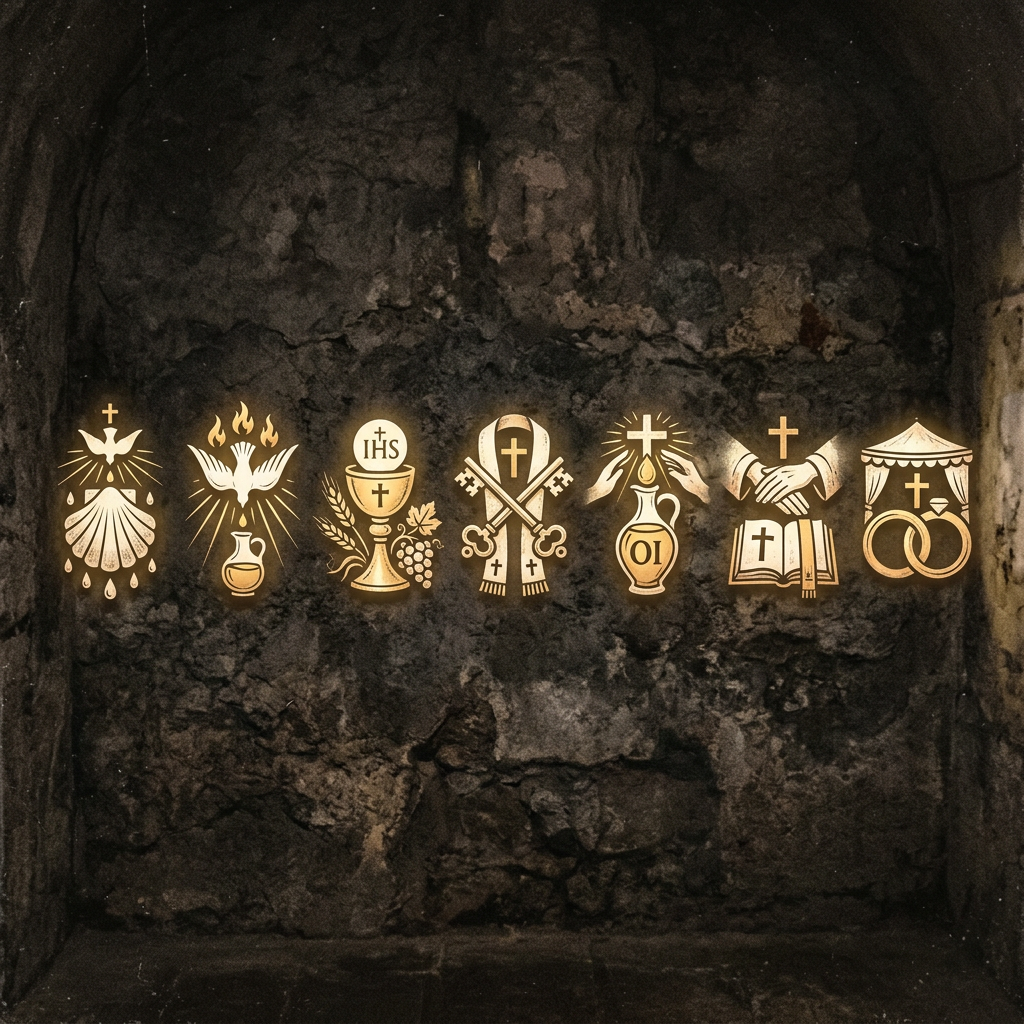
Tag: Sacraments

  • The New Testament Passages which Justify the Seven Catholic Sacraments

    The New Testament Passages which Justify the Seven Catholic Sacraments

           Many protestant sects argue about some of the sacraments being in the Bible, I feel mostly to downplay the necessity or legitimacy of priests.  Now, don’t get me wrong, some people may see certain verses calling out a particular sacrament as a stretch, but those verses do exist. The following is taken from a pamphlet entitled “Christian Doctrine Drills: For use in Parochial Schools,” published by D.B. Hansen & Sons, Chicago, Illinois, publish circa 1964.

    Baptism

         And Jesus coming, spoke to them, saying: “All power is given to Me in heaven andin earth. Go, therefore, teach ye all nations: baptizing them in the name of the Father, and of the Son, and of the Holy Ghost, teaching them to observe all things whatsoever I have commanded you: and behold I am with your all days, even to the consummation of the world (Matt. 28:18-20)

    Confirmation

         Now when the Apostles, who were in Jerusalem, had heard that Samaria had received the word of, they sent unto them Peter and John, who, when they were come, prayed for them, that they might receive the Holy Ghost, for He was not as yet come upon any of them; but they were only baptized in the name of the Lord Jesus.  Then they laid their hands upon them, and they received, the Holy Ghost. (Acts 8:14-17 and John 16:7)

    Holy Eucharist [also known as Holy Communion]

         And whilst they were at supper, Jesus took bread and blessed and broke, and gave it to His disciples, and said: “Take ye and eat: This is My Body.”

         And taking the chalice, He gave thanks, and gave to them saying:  “Drink ye all of this: for this is My Blood of the New Testament which shall be shed for many unto remission of sins.” (Matt. 26:26-28)

    Penance

         Jesus said to them: “Peace be to you. As the Father hath sent me, I also send you.”

         When He had said this, He breathed on them; and He said to them: “Receive thee ye the Holy Ghost. Whose sins you shall forgive, they are forgiven them and whose sins you shall retain, they are retained.” (John 20:21-23)

    Extreme Unction

    Is any man sick among you? Let him bring in the priests of the Church and let them pray for him, anointing him with oil in the name of the Lord.  And the prayer of faith shall save the sick man: and the Lord shall raise him up, and if he be in sins , they shall be forgiven him. (James 5:14-16)[Jesus did not say anything specifically about this because it is essentially Penance and the Holy Eucharists with a special blessing and anointing with oil for his hopeful recovery of health but barring that his immediate entry to heaven]

    Holy Orders

        And taking bead, He gave thanks and broke and gave to them saying: “This is My Body, which is given for you. Do this in commemoration of Me.” (Luke 22:19)

    Matrimony

         What therefore God hath joined together, let no man put asunder (Matt. 19:6)
  • The Path to Forgiveness: Sacraments and Salvation

    The Path to Forgiveness: Sacraments and Salvation

          When younger I though the best and most beneficent gift given to sentient creatures was free will.  But I found that the fact is the best most beneficent gift God gave them was the ability to become intelligent – to have well formed reasoning skills.  I am totally blown away by the fact that any of the angels decided not to remain with God.  Here on Earth if people decide to stray from God, they may have demonic based temptation, human based temptation and ignorance and pride to blame.  In my estimation angels only had half of these to contend with – ignorance and pride.  Theologians I have read postulate that the devil and his angels left due to pride and the only reason they could was they were ignorant of how much better (infinitely better) staying with God would be, because He gave them freewill and did not want them to stay if they did not want to stay, or had reservations about staying.  If they had reservations they should have erred on known good which I think a lot of them logically must have. There was no reason not to want to stay because He had just created them and in line with justice they should have wanted to stay to serve the one that had just made them out of nothing.  The angels, I assume, were aware of the fact that they couldn’t die so the warning God gave Adam and Eve, He could not give them and, short of losing existence they could think of no worst thing that could happen to them.  Unfortunately, their lack of foresight robbed them of the prospect of unimaginable happiness.

           But as in the case of several famous movie stars (Marilyn Monroe), politicians (Seward’s folly), singers (Kurt Colbain) and business men (Ted Turner’s father) a life of physical ease, power or fame does not make up for lack of love in a person’s life and what the angels lost was Love itself – God.  See the effects of Jesus Christs _ God’s Love on the first Christians, and their willingness to die horribly, even with the understanding of their own mortality, produced for them what would haunt them throughout the rest of eternity, not knowing the incredible bliss of the Love of God – the Beatific Vision.  The curiosity that doomed Adam and Eve to damnation before the promise of a savior, would be part of the punishment that would damn the fallen angels for the rest of eternity – the gnawing curiosity of what perfect love would feel like. Theologians also hypothesize they had not witnessed the Beatific Vision – seeing God as he really is, otherwise they would not have the free will to leave.  Only upon deciding to stay with God were angels granted the Beatific Vision. Man of course is granted the Beatific Vision for the same reason as angels, that is deciding to stay with God, no matter what. Wanting God without reservation.

          Why must we give our unconditional affirmation to whatever God wants of us?  Because to have the Beatific Vision we will be fundamentally changed in ways incomprehensible to human beings.  Mark 12:25 says: ”For when they shall rise again from the dead, they shall neither marry, nor be married, but are as the angels in heaven.” As the angels? We have nowhere close to the intellect of angels or the control since they are not affected by the ravages of concupiscence as emphasized here.  God is not going to ask us: is changing X okay, or is changing Y okay?  He will simply change it and if we have reservations on His goodness as with the angels, we really don’t want to be in His presence for all eternity.  This life is to learn to trust him without reservation and to want whatever he wants without reservation (remembering 1 Corinthians 2:9).  ”This is my body and this is my blood” (Luke 22:18-20) must be believed (John 6:26-71), not what we might think or what might be easier to think: “this is a symbol of my body and is a symbol of my blood.”  We must believe the almighty God who created the universe actually transforms, through the priest he sent by way of apostolic succession, who offers the sacrifice of the mass that he is truly the bread and wine, all there, body, blood, Soul and Divinity.

          Similarly in the case of the forgiveness of sins, we must believe only through baptism can original sin and any other sin be removed or having been baptized, if one commits a mortal sin only through the power of an ordained priest and performing the penance he prescribes can sins be forgiven.  Believing anything else, specifically that we can ask God – Jesus Christ, directly is simply lazy or the sin of presumption. Doing a Bing search yield this explanation of presumption: The Catholic Church does not consider presumption itself as a sin, but it is a violation of the virtue of hope. The sin of presumption occurs when a person assumes God’s mercy without genuine repentance or effort to follow His will. This sin can lead to a distorted relationship between human freedom and divine mercy, risking turning faith into a shallow convenience rather than a lived commitment. Salvation remains possible, but only through repentance and a return to God’s grace.

         You may ask why am I of the opinion that these are the only two ways? Well I base my opinion on at least 4 biblical references. First Acts 2:38 which states: But Peter said to them. “Repent and be baptized every one of you in the name of Jesus Christ for the forgiveness of your sins: and you will receive the gift of the Holy Spirit.  For to you is the promise and to your children and to all who are far off, even to all whom the Lord our God calls to himself.”

         Second is Matthew 9:1-8: 2And behold they brought to him one sick of the palsy lying in a bed. And Jesus, seeing their faith, said to the man sick of the palsy: Be of good heart, son, thy sins are forgiven thee. 3And behold some of the scribes said within themselves: He blasphemeth. 4And Jesus seeing their thoughts, said: Why do you think evil in your hearts? 5Whether is easier, to say, Thy sins are forgiven thee: or to say, Arise, and walk? 6But that you may know that the Son of man hath power on earth to forgive sins, (then said he to the man sick of the palsy,) Arise, take up thy bed, and go into thy house. 7And he arose, and went into his house. 8And the multitude seeing it, feared, and glorified God that gave such power to men.

          Now this passage shows how Jesus Christ made clear that only God can forgive sins and partially made the case that he was God with the many signs (miracles) He performed during his life.  In the resurrection, in that He raised himself from the dead, He completed the argument. Now if only God, Jesus Christ can forgive sins, how can saying you are asking Jesus Christ for the forgiveness of sins when he is not there, result in your sins being forgiven? “Christ” or God has to say your sins are forgiven.  But can we in any way get Christ in our midst? According to Matthew 18:19-20, yes.  It says:

    • 19: “Again I say to you, that if two of you shall consent upon earth, concerning anything whatsoever they shall ask, it shall be done to them by my Father who is in heaven.”
    • 20: “For where there are two or three gathered together in my name, there am I in the midst of them.”

    So if two of Jesus followers are together, IF THEY AGREE, and ask the father it shall be done for them.

           The problem with this is you need a second person and they must agree.  Also, it is not clear if Jesus is referring to any of his followers or just his apostles, the first priests and bishops.

          As serious as sin is, and Christs reference on how much harder it is to forgive and offense against God than it is to heal a cripple, should there not be some New Testament Biblical verse referring specifically to the forgiveness of sins, and how to obtain forgiveness of sins?

           The fact is there is, John 20:21-24 reads as follows:

    • 21: Then said Jesus to them again, Peace be unto you: as my Father hath sent me, even so send I you.
    • 22: Whose soever sins ye remit, they are remitted unto them; and whose soever sins ye retain, they are retained.
    • 23: Whose sins ye shall forgive, they are forgiven them; and whose sins ye shall retain, they are retained.
    • 24: But Thomas, one of the twelve, called Didymus, was not with them when Jesus came.
    • 25: The other disciples therefore said unto him, We have seen the Lord. But he said unto them, Except I shall see in his hands the print of the nails, and put my finger into the print of the nails, and thrust my hand into his side, I will not believe.

    In the verses just prior to this we find the apostles are gathered away together in a locked room for fear of the Jews coming after them.  My point is that only the 11 apostles were there.  This strongly suggests that Jesus Christ only gave the first priests/bishops and their chosen successors the power to forgive sins.  The fact that Jesus sent them and that they were to chose successors, should be evident in that it was in the first Chapter of Acts if the Apostles (Acts 1:15-26) those successors, chose the successors, who in turn chose their successors so on and so forth until we get the priests and bishops of the present day.

         The question is even if you can just get another person to agree your sins should be forgiven, if you believed that would be accomplished, knowing the specific way Jesus appeared to want us to be forgiven, would you rather ask another believer, who may gossip, or a priest, who is under the seal of the confessional to tell no one even if threatened with death, in the anonymity of the confessional?

         Now Adam and Eve had a similar problem to the angels and that was they lived in a paradise and needed nothing, and though they knew God created them, because they had the “benefit” of physical bodies and since they had more distractions than the angels who were pure intellect, they might have thought more knowledge might have contributed to making their physical life better. But a concept that, I think, God has needed to teach thinking beings is there is a happy medium in everything. In life you must pray, be brave, meditate on God’s word and follow where we feel his words are leading us.  If where God is leading us seems to hard or dangerous, we can be classified as “cowardly,” avoid doing it and miss opportunities to improve either our spiritual lives or our physical lives, or both. If we try and do things which seem great, without proper meditation on the consequences, prayer and caution, we may do something which could be classified as “foolhardy” or “stupid” and lose either our happiness, our lives or quite possibly out souls doing it.  

         Good parents must foster the creation of a “right conscience” and if they can accomplish this then relying on conscience as to what to do in certain cases as touted by modern day clerics can be an acceptable solution.  But if one’s conscience is not well formed it will lead to damnation. But part of the sacrament of confession is not only the psychological reinforcement it gives us from telling someone else (which beats $70/hour psychotherapy session), it gives us the additional reinforcement of a priest (God’s Judicial arbiter and representative as a district court judge represents the country he is a judge for) prescribing your punishment (your penance, what you need to do to have your sins forgiven which may include turning yourself in for a crime to saying the prayers the priest asks you to say) and saying your sins are forgiven.

    This training of the conscience and also the training of the will is an important part of raising a good Catholic child, one who will fulfill their ultimate destiny to make it to heaven and be eternally happy.

  • Books on the Sacraments

    There are so many books on the sacraments because of their importance to the religion – Roman Catholicism.  They impart sanctifying grace, the actual life of God Himself.  For this reason I am only citing 4 books or sets of books, one with complete technical detail for the clergy (Deacons, sisters, priest bishops etc.) and those wishing to learn about the sacraments in detail possibly for Ph.d studies, a second more concise technical book that is suitable for the laity who desire a more in depth look into the principles of sacramental Theology, one for the laity, and one for children. One of the most technically detailed and evidently precises series of books covering all the sacraments appear to be those by the Rt. Rev. Msgr. Joseph Pohle, Ph.D., D.D.  It was produced up to a Sixth Revised Edition, for some volumes, by B. Herder Book Co.  The books are called “The Sacraments” (Vol. 1-4) and are specifically, with the identifiers being for the latest reprints and the approbations being from the originals:

    The Sacraments: A Dogmatic Treatise, Volume I The Sacraments in General. Baptism. Confirmation.

    Publisher ‏ : ‎ Palala Press (November 15, 2015)

    Hardcover ‏ : ‎ 342 pages

    ISBN-10 ‏ : ‎ 1346352615

    ISBN-13 ‏ : ‎ 978-1346352619

    Original by B. Herder has a 1915 copyright and the following official approbations:

    Nihil Obstat: Sti. Ludovici, die 8. Julii, 1931,

                         Joannes Rothensteiner,

                         Censor Liborum

    Imprimatur: Sti. Ludovici, die 9. Julii, 1931,

                        + Joannes J. Glennon,

                        Archiepiscopus

    The Sacraments: A Dogmatic Treatise, Volume II The Holy Eucharist

    ASIN ‏ : ‎ B0BKMS5BCV

    Publisher ‏ : ‎ Independently published (October 11, 2022)

    Hardcover ‏ : ‎ 376 pages

    ISBN-13 ‏ : ‎ 979-8357611338

    Nihil Obstat: Sti. Ludovici, die 26. Aug., 1930,

                         Joannes Rothensteiner,

                         Censor Liborum

    Imprimatur: Sti. Ludovici, die 28. Aug,, 1930,

                        Patricius Paulus Crane, V.G.

    The Sacraments: A Dogmatic Treatise, Volume III Penance

    Publisher ‏ : ‎ Legare Street Press (October 27, 2022)

    Hardcover ‏ : ‎ 280 pages

    ISBN-10 ‏ : ‎ 1017835810

    ISBN-13 ‏ : ‎ 978-1017835816

    Nihil Obstat: Sti. Ludovici, die 28. August, 1933,

                         F, J. Holweck

                         Censor Liborum

    Imprimatur: Sti. Ludovici, die 29. August, 1933,

                        P. P. Crane, V.G.

    The Sacraments: A Dogmatic Treatise, Volume IV Extreme Unction – Holy Orders Matrimony

    ASIN ‏ : ‎ B0BHMPMMF8

    Publisher ‏ : ‎ Independently published (October 11, 2022)

    Hardcover ‏ : ‎ 223 pages

    ISBN-13 ‏ : ‎ 979-8357605443

    Nihil Obstat: Sti. Ludovici, die 9. Feb., 1929,

                         H. Hussmann,

                         Censor Liborum

    Imprimatur: Sti. Ludovici, die 11. Feb., 1929,

                        + Joannes J. Glennon,

                        Archiepiscopus

    The second book is “Principles of Sacramental Theology” by Bernard Leeming, S.J. which was available second hand on amazon.

    ASIN ‏ : ‎ B0028TTCUA

    Publisher ‏ : ‎ Longmans; Revised Edition (January 1, 1960)

    Imprimi Potest: J.D. Boyle, S.J.

                             Praep. Prov. Angle. Soc. Jesu

                             Die 23 februarii 1955

    Nihil Obstat: Joannes M.T. Barton, S.T.D., L.S.S.

                         Censor Depvtatvs

    Imprimatvr: E. Morrogh Bernard

                       Vicarivs Generalis

    Westmonasterii: Die XXII A Novembris MCMLV

    This third book is less technical and for the layman is “Christ Acts through Sacraments” by A.-M. Roguet, OP:

    Publisher ‏ : ‎ Hassell Street Press (September 9, 2021)

    Hardcover ‏ : ‎ 194 pages

    ISBN-10 ‏ : ‎ 1013868722

    ISBN-13 ‏ : ‎ 978-1013868726

    Nihil Obstat: Eduardus Mahoney, S.T.D.,

                         Censor Deputatus

    Imprimatur: E. Morrogh Bernard

                        Vic. Gen.

    Westmonasterii, die 5a Novembris, 1953

    The sacraments are of such importance that even children should be schooled in their existence, function, background and importance.  I think I mention this particular book in the list of books for children.  The name of the book is “The Seven Sacraments” and is authored by Father L. Lovasik, S.V.D.

    Publisher ‏ : ‎ Catholic Book Publishing; First Edition (January 1, 1978)

    Paperback ‏ : ‎ 32 pages

    ISBN-10 ‏ : ‎ 0899422780

    ISBN-13 ‏ : ‎ 978-0899422787

    Reading age ‏ : ‎ 4 – 8 years

    Grade level ‏ : ‎ Kindergarten – Preschool

    Nihil Obstat: Daniel V. Flynn, I.C.D.,

                         Censor Librorum

    Imprimatur: + James P. Mahoney, D.D.

                          Vicar General,

                          Archdiocese of New York