
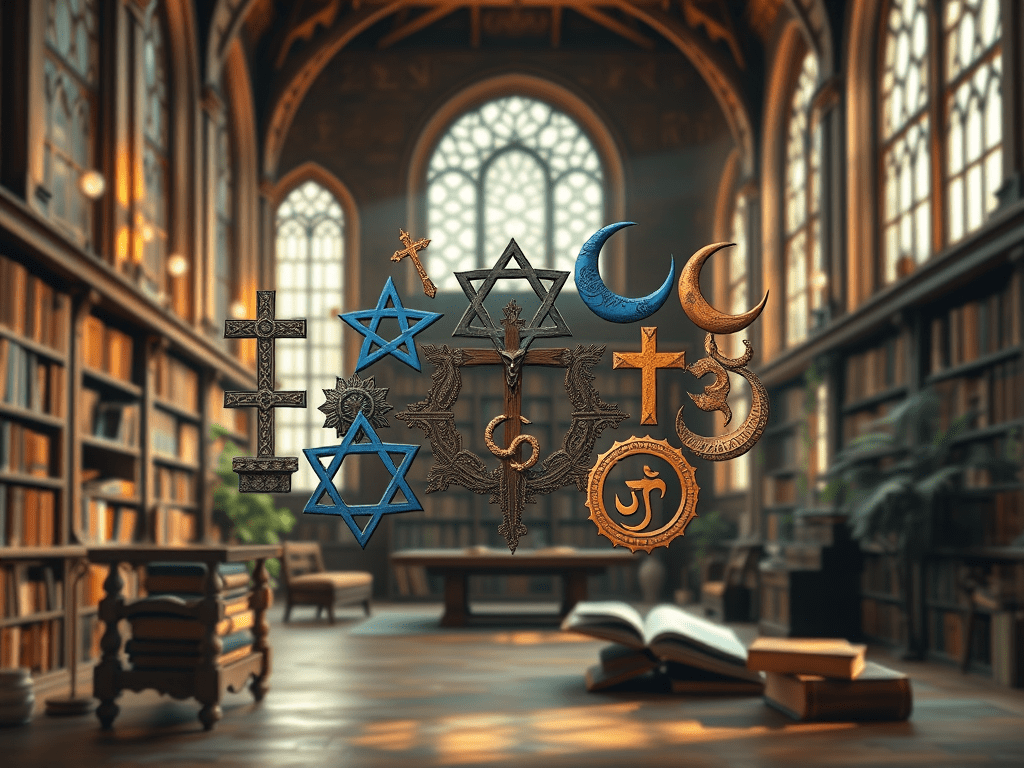
These courses concentrate on the largest religions/philosophies on earth today as well as touch on the Pagan religions with an emphasis on the larger religions, specifically Confucianism/Hinduism (the great Asian religions), Judaism, Catholicism, Muhammadism/Islam and Protestantism. The courses outlined will be as follows:
- Cultural Literacy for Religion: Everything the Well-Educated Person Should know.
- Comparative Religion
- The Pagan World: Ancient Religions before Christianity
- Jesus and His Jewish Influences
- Confucius, Buddha Jesus, and Muhammad
- Beginnings of Judaism
- The World of Biblical Isreal
- The Book of Genesis
- The Dead Sea Scrolls
- Myth in Human History
- Luther: Gospel, Law and Reformation
The first course we will cover is one on “Cultural Literacy for Religion: Everything the Well-Educated Person Should know.” The lecturer is Professor Mark Berkson, an Associate Professor and Chair in the Religion Department at Hanline University. Professor Berkson is a regular presenter on religious issues fo conferences, universities, community groups, and churches and has been featured on television and radio news shows. His work has appeared in such prestigious journals as the Journal of Religious Ethics, Teaching Theology & Religion and Buddhist-Christian Studies.
Disc 1
Lecture 1: Religion – its Meaning and importance
Lecture 2: Facets of Religion – Divinity and Devotion
Lecture 3: Hinduism – Foundational Texts and Teachings
Lecture 4: Hindu gods and Devotional Practices
Lecture 5: Gita to Gandi – Yogas and Modern Hinduism
Lecture 6: Waking Up Buddha and His Teachings
Disc 2
Lecture 7: Vehicles to Nirvana – The Schools of Buddhism
Lecture 8: Chinese Religion and Cosmology
Lecture 9: Confucianism – Rituals and Relationships
Lecture 10: Daoism – Harmony, Nature, and the Way
Lecture 11: Kami and Spirits – Shinto and Shamanism
Lecture 12: East Asian Buddhism – Zen and Pure Land
Disc 3
Lecture 13: Judaism – God, Torah, and Covenant
Lecture 14: Varieties of Jewish Thought and Practice
Lecture 15: Living a Jewish Life
Lecture 16: The Life and Commemoration of Jesus
Lecture 17: Catholic and Orthodox Christianity
Lecture 18: Protestantism and Christianity today
Disc 4
Lecture 19: Muhammad, Qur’an, and Islamic civilization
Lecture 20: Unity in Islam – the Five Pillars
Lecture 21: Forms of Islam – Diversity among Muslims
Lecture 22: Jains, Sikhs, and Baha’is
Lecture 23: Religion and Law in America
Lecture 24: Religion Today – Trends, Challenges, and Hope
The next course is actually called “Comparative Religion.” The lecturer is Professor Charles Kimball. He is the presidential professor and Director of the Religious Studies Program at the University of Oklahoma Former director of the Middle East Office at the National Council of Churches. Professor Kimball is a frequent lecturer and analyst on issues in Jewish-Christian-Muslim relations, Professor Kimball’s books include When Religion Becomes Evil, named one of Publishers Weekly’s Top 15 Books on Religion in 2002.
Disc 1
Lecture 1: Comparative Religion – Who, What , Why How
Lecture 2: Exploring Similarities and Differences
Lecture 3: The Sacred, the Holy, and the Profane
Lecture 4: Sacred Time, Sacred Space, Sacred Objects
Lecture 5: Sacred People – Prophets, Sages, Saviors
Lecture 6: Sacred People – Clergy, Monastics, Shamans
Disc 2
Lecture 7: Sacred Sign, Analogs, and Sacraments
Lecture 8: Creation Myths and Sacred Stories
Lecture 9: From Sacred Stories and Letters to doctrine
Lecture 10: Sacred Text – The Bible and the Qur’an
Lecture 11: Sacred Texts for Hindus and Buddhists
Lecture 12: Polytheism, Dualism, Monism and Monotheism
Disc 3
Lecture 13: From Birth to Death – Religious Rituals
Lecture 14: Daily, Weekly, Annual Religious Rituals
Lecture 15: Ritual Sacrifice in the World’s Religions
Lecture 16: The Human Predicament – How to Overcome It
Lecture 17: The problems of sin and forgetfulness
Lecture 18: Breaking through the Illusion of Reality
Disc 4
Lecture 19: The Goals of Religious Life
Lecture 20: The Way of Faith and the Way of Devotion
Lecture 21: The Way of Action and the Way of Meditation
Lecture 22: The Way of the Mystics
Lecture 23: The Evolution of Religious institutions
Lecture 24: Religious Diversity in the 21st Century
The next courses is entitled “The Pagan World: Ancient Religions before Christianity.” As the summary on the back of the set says the purpose of the course is to: “Take a close, Behind-the-scenes look at religion and life in the ancient Mediterranean to see how early pagan religions helped shape the world as we know it.” The lecturer is Hans-Fredrich Mueller. He is the Thomas Lamont Professor of Ancient and Modern Literature at Union College. He earned his PhD in Latin from the University of North Carolina at Chapel Hill. Professor Mueller received the American Philological Association’s Award for Excellence in the Teaching of Classics at the College Level in addition to numerous articles. Professor Mueller is the author of Roman Religion in Valerius Maximus and editor of an abridged edition of Gibbon’s Decline and Fall of the roman Empire.
Disc 1
Lecture 1: Early Pagan religion in Mesopotamia
Lecture 2: The Rigveda and the Gods of Ancient India
Lecture 3: State Religion in Ancient Egypt
Lecture 4: From Myth to Religion: The Olympian Deities
Lecture 5: Household and local Gods in Ancient Greece
Lecture 6: Feeding the Gods: Sacrificial Religion
Disc 2
Lecture 7: Prayers, Vows, Divination and Omens
Lecture 8: Delphi and other Greek Sanctuaries
Lecture 9: Cults and Mystery Religions
Lecture 10: Philosophical Critiques of Paganism
Lecture 11: Greek Funerary Practices and the Afterlife
Lecture 12: Egyptian influences on Ancient Religion
Disc 3
Lecture 13: Ancient Roman Ancestor Worship
Lecture 14: God of the Roman Household
Lecture 15: Gods of the Roman State
Lecture 16: Priests and Ceremonies in the Roman Republic
Lecture 17: Religion, Politics, and War in Rome
Lecture 18: Romes Reactions to Foreign Religions
Disc 4
Lecture 19: The Roman Calander and Sacred Daus.
Lecture 20: Julius Ceasar: A Turning Point in Roman Religion
Lecture 21: Emperor Worship in Rome
Lecture 22: Zoroastrians, Jews, and Christians
Lecture 23: Popular Religions of Late Antiquity
Lecture 24: The End of Paganism in the Roman Empire
The next Course is entitled “Jesus and His Jewish Influences,” Which is once again self-explanatory. The lecturer is Dr. Jodi Magness. She is the Kenan Distinguished Professor for Teaching Excellence in Early Judaism at the The University of North Carolina at Chapel Hill. She earned her PH.D in Classical Archaeology from the University of Pennsylvania and has received many teaching and academic awards,. An archaeologist with extensive field experience in Isreal. Dr. Magness also has published a number of books, including The Archaeology of the Holy Land: From the Destruction of Solomon’s Temple to the Muslim Conquest.
Disc 1
Lecture 1: Jesus the Jew
Lecture 2: Sacred Mountains and Law Giving in Judaism
Lecture 3: The United and Divided Israelite Kingdoms
Lecture 4: The Destruction of Solomon’s Temple
Lecture 5: The Jewish Samaritan Schism
Lecture 6: The Jewish Diaspora and the Golden Rule
Disc 2
Lecture 7: Alexander the Great’s Impact on the Jews
Lecture 8: Jews and Greek Rule: The Heliodorus Affair
Lecture 9: Desolating Sacrilege and the Maccabean Revolt
Lecture 10: Apocalyptic Works and the “Son of Man”
Lecture 11: Jesus’s Jewish Lineage
Lecture 12: Was Jesus a Pharisee?
Disc 3
Lecture 13: Jewish Ritual Purity: The Sons os Light
Lecture 14: The Dead Sea Scrolls
Lecture 15: Was Jesus and Essene?
Lecture 16: The Hebrew Scripture and the Septuagint
Lecture 17: The reign of Herod the Great
Lecture 18: Pontius Pilate a Roman Prefect
Disc 4
Lecture 19: Anarchy in Judea
Lecture 20: Jesus’s Prophecy: Jerusalem’s Destruction
Lecture 21: Flavius Josephus: Witness to 1st Century AD
Lecture 22: Rabbinic Judaism’s Traditions about Jesus
Lecture 23: Jesus’s Apocalyptic Outlook
Lecture 24: Jesus’s Teachings and Sayings in Context
The next course is called “Confucius, Buddha Jesus, and Muhammad.” It looks at each of these religious leaders and eventually compares them. The lecturer for this course is Professor Mark W. Muesse. He is and Associate Professor of religious Studies and currently Director of the Asian Studies Program a Rhodes College.
Disc 1
Lecture 1: A quartet of Sages
Lecture 2: Confucius’s China
Lecture 3: Becoming a Sage
Lecture 4: A Gentleman and a Scholar
Lecture 5: Heaven and Earth
Lecture 6: Doing unto Others
Disc 2
Lecture 7: How to Rule a Kingdom
Lecture 8: What a Sage Does
Lecture 9: Confucius and Confucianism
Lecture 10: India at the Time of the Buddha
Lecture 11: Siddhartha Gotama
Lecture 12: The First and Second Great Awakenings
Disc 3
Lecture 13: Knowing the World
Lecture 14: Can’t Get No Satisfaction
Lecture 15: Getting to the Farther Shore
Lecture 16: How the Buddha Taught
Lecture 17: The Buddha and Buddhism
Lecture 18: The Jewish and Roman Worlds of Jesus
Disc 4
Lecture 19: The Son of Mary
Lecture 20: The first 30 Years
Lecture 21: The Kingdom of God
Lecture 22: Back to the Future
Lecture 23: Jesus Christology
Lecture 24: The Last Days in Jerusalem
Disc 5
Lecture 25: How Jesus Became Christ
Lecture 26: Arabia in the Days of Ignorance
Lecture 27: The Trustworthy One
Lecture 28: “I Am Only a Messenger”
Lecture 29: Madinah
Lecture 30: “There is No God But al-Lah”
Disc 6
Lecture 31: The Ethics of Islam
Lecture 32: The Greater Jihad
Lecture 33: The Conquest of Makkah
Lecture 34: Their Lives Compared
Lecture 35: Their Teachings Compared
Lecture 36: Their Enduring Significance
The next course is the “Beginnings of Judaism” once again whose title is self-explanatory. The Lecturer is Professor Isaiah M. Gafni has taught students about ancient Judaism for mor than 40 years at The Hebrew University in Jerusalem, where he is the Sol Rosenbloom Professor of Jewish History. His more than 15 books include The Jews of Talmudic Babylonia: a Social and Cultural History, winner of the Holon Prize in Jewish Studies. For his exceptional teaching, Professor Gafni received Hebrew University’s acclaimed Michael Milken Prize.
Disc 1
Lecture 1: The Beginnings of Judaism – Biblical Roots
Lecture 2: New Challenges in the Late Biblical Period
Lecture 3: Jews under Persian Rule – The Return to Zion
Lecture 4: The Challenge of Hellenism
Lecture 5: The Maccabees – From Rebels to Kings
Lecture 6: The Canonization of the Hebrew Bible
Disc 2
Lecture 7: Translating the Bible – The Septuagint
Lecture 8: Adding to the Bible – The Apocrypha
Lecture 9: Tobit – A New Path of Righteousness
Lecture 10: Retelling the Bible – The Book of Jubilees
Lecture 11: Revealing the Unknown
Lecture 12: “Judaism” or “Judaisms?
Disc 3
Lecture 13: Sectarianism – Pharisees and Sadducees
Lecture 14: Out of the Caves – Discovery at Qumran
Lecture 15: The End of Days – Messianic Eschatology
Lecture 16: Other Lands, Other Jews – The Diaspora
Lecture 17: Judaism in the Hellenistic World
Lecture 18: Changing God’s Address – Temple to Synagogue
Disc 4
Lecture 19: Rome Arrives in Jerusalem
Lecture 20: Parting with the Temple
Lecture 21: From Jerusalem to Yavne -Rabbinic Judaism
Lecture 22: The Shaping of Rabbinic Judaism
Lecture 23: A Violent Epilogue – Bar Kokhba
Lecture 24: From “Roots” to “Tree”
The next title is “The World of Biblical Isreal.” World is sort of an amorphous term. In this case the lecturer talks about the day to day customs (worship, meals, etc.), politics, economy, literacy, education, living in certain times and things such as the Assyrian Incursion into Isreal and Judah. The lecturer is Professor Cynthia R. Chapman, an Associate Professor of Biblical Studies at Oberlin College of Arts and Sciences, where she has taught for 11 years. She holds an M.Div from Vanderbilt Divinity School and a Th.D from Harvard Divinity School. At Oberlin, she offers courses in Old and New Testaments, biblical women, and other topics. Professor Chapman’s research has focused on the historiography of the Bible considered with in the larger ancient Near Eastern environment and on gender in ancient Isreal. Her first book was entitled The Gendered Language of Warfare in the Israelite-Assyrian Encounter.
Disc 1
Lecture 1: Biblical Isreal – The Story of a People
Lecture 2: By the Rivers of Babylon – Exile
Lecture 3: Ancestor Narratives in Genesis
Lecture 4: Moses – The Torah’s Central Hero
Lecture 5: Becoming the Nation of Isreal
Lecture 6: Kinship and Economics in Highland Villages
Disc 2
Lecture 7: Three Wedding and a Funeral
Lecture 8: Political Power Basics in Early Isreal
Lecture 9: Kingdoms and King Making
Lecture 10: Politics and Economy of a Centralized Cult
Lecture 11: Worshiping Locally
Lecture 12: Lives of the Rich, Lives of the Poor
Disc 3
Lecture 13: Assyrian Incursion into Isreal of Judah
Lecture 14: Life under Siege
Lecture 15: Religious Debates and Preserved Text
Lecture 16: Ezekiel – Exilic informant
Lecture 17: Life in Exile, Life in Judah
Lecture 18: Literacy and Education
Disc 4
Lecture 19: Religious Developments of the Exile
Lecture 20: The New Isreal – Resettling the Land
Lecture 21: Food and the Family Meal – Boundaries
Lecture 22: National Identity – Intermarriage
Lecture 23: National Identity – Twins and Enemies
Lecture 24: Loss and Restoration – Two Biblical Stories
The next course is entitled “The Book of Genesis.” This is about the stories in the first book of the Bible, the first book of the New Testament. The lecturer is Professor Gary A. Rendsburg who holds the Blanche and Irving Laurie Chair in Jewish History in the Department of Jewish Studies at Rudgers University. An expert in the history of ancient Isreal and the literature of the Bible, he has spent decades immersed in the study and exploration of Qumran and other ancient sites in Isael, Egypt, and Jordan. Among his more than 120 scholarly articles and books is the Bible and the Ancient near East.
Disc 1
Lecture 1: On Reading the Book of Genesis
Lecture 2: Genesis 1: The Creation Story
Lecture 3: Genesis 2-3: The Second Creation Story:
Lecture 4: An Overview of Ancient Israelite History
Lecture 5: The Ancient Near East
Lecture 6: The JEDP Theory – The Alternative Approaches
Disc 2
Lecture 7: Genesis 6-8, the Flood Story
Lecture 8: Genesis 9, Covenant
Lecture 9: Genesis 12-22, the Abraham Story
Lecture 10: When and Where Did Abraham Live?
Lecture 11: Genesis 21-22, Abraham Put tot the Test
Lecture 12: Women in the Bible – Sarah and Hagar
Disc 3
Lecture 13: Genesis 24: A Bride for Isaac
Lecture 14: The Barren Woman and the Younger Son
Lecture 15: The Literary Structure of Genesis
Lecture 16: Different Bible Translations
Lecture 17: Genesis 27, Jacob and Esau
Lecture 18: Genesis 29, Jacob and Rachel
Disc 4
Lecture 19: The Date of the Book of Genesis
Lecture 20: Genesis 37, Joseph and His Brothers
Lecture 21: Genesis 38, The Story of Judah and Tamar
Lecture 22: Genesis 39, The Story of Potipher’s Wife
Lecture 23: The Egyptian background of the Joseph Story
Lecture 24: One Last Text – and the Text as a Whole
The next course covered in this blog is titled “The Dead Sea Scrolls.” The following description is taken from the google AI Overview: The Dead Sea Scrolls are ancient religious manuscripts, primarily dating from the 3rd century BCE to the 1st century CE, discovered in caves near the Dead Sea. They consist of about 950 different manuscripts, with many found as fragments, and include biblical texts, sectarian documents, and other Jewish religious works written in Hebrew and Aramaic. They are considered one of the most significant archaeological finds of the 20th century, offering invaluable insights into Judaism and the world of early Christianity. This incudes Biblical manuscripts where approximately 40% of the scrolls are copies of books from the Hebrew Bible, providing the oldest known versions of these texts. While the scrolls do not mention Jesus, they provide critical historical and theological context for the world in which he lived, showing that many of the ideas and expectations discussed in his ministry were topics of conversation among Jewish groups at the time. An Interesting article containing fascinating facts can be found at: https://guideposts.org/angels-and-miracles/miracles/the-dead-sea-scrolls-11-fascinating-facts/?utm_source=google&utm_medium=cpc&utm_campaign=&utm_term=&gad_source=1&gad_campaignid=22710552711&gbraid=0AAAAADzKssNXOsTTnRsEatrz1PNoptcIB&gclid=Cj0KCQjw9czHBhCyARIsAFZlN8Sk9Yn1Amn0_VzK0L4mdYWG0aFQXDhZHth0tPwTsHzohASmMuR2hx8aAsuYEALw_wcB
The lecturer is the same as the previous course outlined – Professor Gary A Rendsburg.
Disc 1
Lecture 1: The Discoveries and Their Significance
Lecture 2: The First Seven Scrolls
Lecture 3: Opening and Reading the First Scroll
Lecture 4: The Historical Backdrop of Ancient Judaism
Lecture 5: The Rise of the Jewish Sects
Lecture 6: The Dead Sea Site
Disc 2
Lecture 7: The Emergence of the Rabbinic System
Lecture 8: A Dead Sea Scroll form Medieval Cairo
Lecture 9: Pesher Interpretation – Prophecy Read Anew
Lecture 10: The War Scroll and other Apocalyptic Texts
Lecture 11: Biblical Manuscripts at Qumran
Lecture 12: Alternative Views of Qumran and the Scrolls
Disc 3
Lecture 13: Stops and Starts En Route to Publication
Lecture 14: The Qumran Vision for a New Temple
Lecture 15: Daily Life of Qumran
Lecture 16: The Halakhic Letter – Rituals Define the Sect
Lecture 17: The Qumran Biblical Canon
Lecture 18: The Qumran Calander
Disc 4
Lecture 19: Jewish Scholars and Qumran Ritual Practices
Lecture 20: Prayers, Hymns, and the Synagogue
Lecture 21: Qumran Hebrew as an Anti-Language
Lecture 22: The Enigma of the Copper Scroll
Lecture 23: Connections to Christianity
Lecture 24: Scroll Fragments and a New View of Judaism
The second to last course outlined in this blog is entitled “Myth in Human History.” The lecturer is Professor Grant L. Voth. He is Professor Emeritus in English and Interdisciplinary Studies of Monterey Peninsula College and an expert in literature from Around the world. A former Professor at Northern Illinois University and Virgina Tech. Professor Voth is the author of more than 30 books and articles on subjects raging from Shakespear to modern American fiction His distinguished awards include the Alien Griffin Award for Excellence in Teaching.
Disc 1
Lecture 1: Myth and Meaning
Lecture 2: The Continuing Importance of Myth
Lecture 3: Creation Myths
Lecture 4: Mesopotamian Creation – Enuma Elish
Lecture 5: Hebrew Creation Myths
Lecture 6: Emergence and World–Parent Creation Myths
Disc 2
Lecture 7: Cosmic Egg and Ex Nihlio Creation Myths
Lecture 8: Earth-Diver and Dismembered God Creation Myths
Lecture 9: Mesopotamian and Hebrew Flood Myths
Lecture 10: Other Flood Myths
Lecture 11: Myths of Cosmic destruction
Lecture 12: Greek and Norse Pantheons
Disc 3
Lecture 13: The Great Goddess Remembered?
Lecture 14: The Goddess – Inanna and Dumuzi
Lecture 15: The Goddess – Isis and Osiris
Lecture 16: The Eclipse of the Goddess
Lecture 17: Shamans and Vegetation Gods
Lecture 18: Sky Gods and Earth Goddesses
Disc 4
Lecture 19: Creator Gods
Lecture 20: Gods and Goddesses of India
Lecture 21: Hero Myths
Lecture 22: Mythic Heroes – Gilgamesh
Lecture 23: Mythic Heroes – King Arthur
Lecture 24: Mythic Heroes – Jason and the Argonauts
Disc 5
Lecture 25: The Monomyths of Rank and Campbell
Lecture 26: Mythic Heroes – Mwindo
Lecture 27: Female Heroes – Demeter and Hester Pryhee
Lecture 28: Female Heroes – Psyche and Beauty
Lecture 29: The Trickster in Mythology
Lecture 30: Tricksters from around the World
Disc 6
Lecture 31: Native American Tricksters
Lecture 32: African Tricksters
Lecture 33: Mythic Tricksters – Eshu and Legba
Lecture 34: The Places of Myth – Rocks and Lakes
Lecture 35: The Places of Myth – Mountains
Lecture 36: The Places of Myth – Sacred Trees
The Final course outlined in this blog is “Luther: Gospel, Law and Reformation” which is about Martin Luther, the progenitor of the Protestant movement. The Lecturer is Professor Phillip Cary. He is Director of the Philosophy Program at Eastern University (formerly Eastern College) is St Davids, Pennsylvania, where he is also Assistant Professor in the Templeton Honors College. He received his M.A. in Philosophy and Ph.D in Philosophy and Religious Studies from Yale Univesity. He has published several papers on St. Augustine and other topics. He is author of Augustine’s Invention of the Inner Self: The Legacy of a Christian Platonist.
Disc 1
Lecture 1: Luther’s Gospel
Lecture 2: The Medieval Church – Abuses and Reform
Lecture 3: The Augustinian Paradigm of Spirituality
Lecture 4: Young Luther Against Himself
Lecture 5: Hearing the Gospel
Lecture 6: Faith and works
Disc 2
Lecture 7: The Meaning of the Sacraments
Lecture 8: The Indulgence Controversy
Lecture 9: The Reformation Goes Public
Lecture 10: The Captivity of the Sacraments
Lecture 11: Reformation in Wittenberg
Lecture 12: The Work of the Reformer
Disc 3
Lecture 13: Against the Spirit of Rebellion
Lecture 14: Controversy Over the Lord’s Supper
Lecture 15: Controversy Over Infant Baptism
Lecture 16: Grace and Justification
Lecture 17: Luther and the Bible
Lecture 18: Luther and Erasmus
Disc 4
Lecture 19: Luther and Predestination
Lecture 20: Luther and Protestantism
Lecture 21: Luther and Politics
Lecture 22: Luther and His Enemies
Lecture 23: Luther and the Jews
Lecture 24: Luther and Modernity
The different perspectives and dimensions of Jesus, the Bible and religions in general are almost infinite, each giving us a deeper look into the ultimate reality.
 Traditional Thomistic Catholic